Close Menu
Menu
Social isolation is on the rise. In fact, it’s an epidemic.
In light of this crisis, it is no wonder that people are feeling more compelled to find ways to connect. Unfortunately, at the time we need them most, we are losing our hangout spots, our meet-up points, our usual gathering places. Our communities are starting to feel the absence of places where people can go to meet with friends, have informal exchanges with acquaintances, or just get out of the house.
These are what are often called “third places,” the places other than our homes (first places) and workplaces (second places) in which our social lives play out.
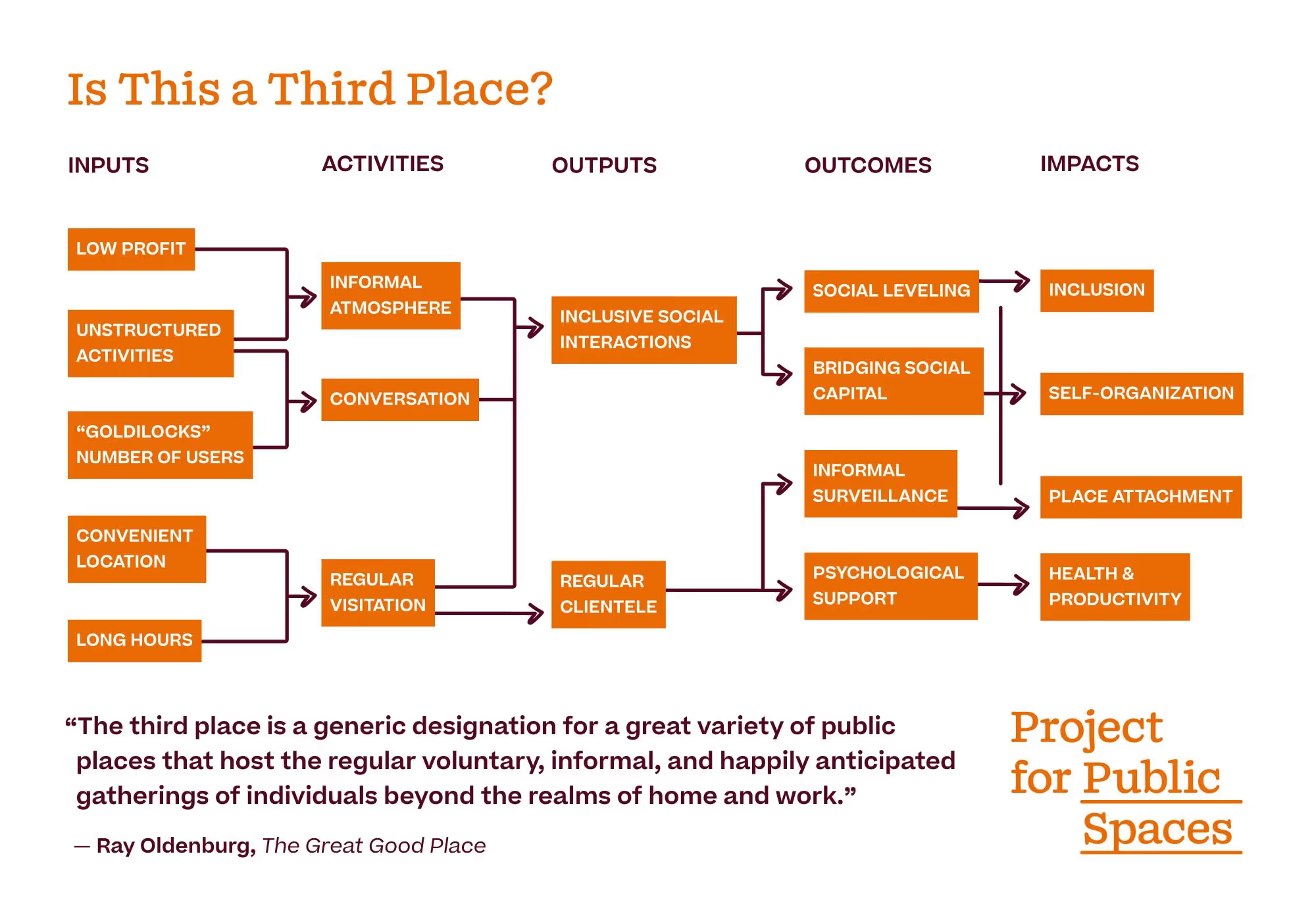
In what is widely considered the foundational text on third places, The Great Good Place, author Ray Oldenburg devised the term as “a generic designation for a great variety of public places that host the regular, voluntary, informal, and happily anticipated gatherings of individuals beyond the realms of home and work.” Emphasizing that these places are inclusive and have strong local ties, Oldenburg describes them as places that “offer both the basis of community and the celebration of it.” They are the accessible, everyday places that we go to unwind, to catch up, to feel involved in the goings-on of our neighborhood.
The current spike in loneliness parallels what has become an increasingly well-recognized disappearance of third places. People have noticed the absence of institutions that filled this role, whether it’s the neighborhood café or the corner pub or the hair salon, so much so that the phenomenon is being flagged as a potential health risk.
Unfortunately, this newfound attention to the concept of third places means that the term is thrown around quite a bit, with some using this designation for things that are decidedly not third places. While you certainly can hang out in an expensive cocktail bar, it’s not very affordable to linger there for long. A big downtown park may draw thousands of people every weekend from across the region, but does it foster the habitual, regular use and long conversations that builds up strong relationships? Not even coffee shops—the classic examples of the third place—can be consistently relied upon to serve this role?

So how do we find and create genuine third places to connect outside of our home and work life? These critical social spaces are defined first and foremost by the activities that take place there and the benefits of those activities. This article is a guide to breaking down how third places really work.
Third places are far from simple, but certain factors make a space much more likely to play this vital role. From convenience to reliability to flexibility, a few key inputs make third places possible.
The Pass in San Antonio, Texas, is a third place that shows how an underused area can be transformed with a few ingredients. With support from the Clarity Parks Project, Project for Public Spaces worked with local organizations and students here to reimagine what was once an neglected underpass as a place to spend quality time, and see how it works as a third place first hand. Envisioned as an after-school hangout, it now serves as a space for homework and study sessions, skateboarding, and watching or playing basketball on the new courts.
But these improvements built upon the appeal of the underpass’s convenient location near Historic Market Square and University of Texas - San Antonio, one of the key ingredients of a third place. The effort also supplemented the site’s natural shade during Texan summers with new seating, swinging benches, and, charging stations to make it easier and more comfortable for young people to linger.

Part of what makes the space appealing is that it offers more than it demands of its visitors. Third places perform best when operating with low or no profit expectations, and when they support affordable, unstructured activities. In large part because it is “free to be there” and conveniently close to other local hubs of activity, The Pass provides a supportive environment for everyday encounters.
With its amenities and informal activities, the Pass invites another key element of third places: a “Goldilocks” number of users. An over-crowded space can be intimidating, while too few people means visitors are less likely to bump into acquaintances. The key is striking a balance of enough people to make a place seem appealing, without being overwhelming.
Moreover, a space is more likely to fit the bill as a third place if it is reliable. Third places need to be a fixture in an area, not just a one-off networking event. To stay adaptable to frequent visitors, they should ideally be open for long hours. This flexibility means that a place can become a mainstay in people’s normal routines.
Though The Pass’s transformation benefitted from new murals and landscaping, not every third place needs to be beautiful—sometimes older and simpler venues are best. Oldenburg argued that being “low profile” is beneficial, and that while newcomers need to be welcomed in third places, a bit of roughness around the edges can maintain a healthy sense of authenticity and ownership among regulars and deter too many one-time visitors.
Third places don’t always have programming to keep them busy. Though many happen to be “watering holes” (serving drinks), at their most basic they simply need to provide a place to talk. In fact, Oldenburg’s original description of a third place is one in which “conversation is the primary activity and the major vehicle for the display and appreciation of human personality and individuality.” Making people comfortable enough to connect with one another and express themselves is the key feature of a high-performing third place.
Offering a unique example of what third places can be, Project for Public Spaces worked with Downtown Arlington and local residents to transform the Doggie Depot in Arlington, Texas, from an unused buffer lawn next to a railroad track into a green space designed for dog owners. What locals asked to have on the lot was simple: a shaded place to sit, and a clean, safe enclosure to let their dogs roam and play. The site has become a well-used dog park, with amenities like dog waste stations, lights, fenced areas for different sizes of dogs, and plenty of benches.
In this new space, dogs have even become a conversation starter. Public space researcher William H. Whyte called this phenomenon triangulation; dogs, babies, performers, public art, and other things that invite comment can create a third point between two strangers, making it easier for them to interact. And once the ice is broken, these connections are more likely to grow over time because of the daily usefulness of the space. Dogs need walks every day, making regular visitation more likely.
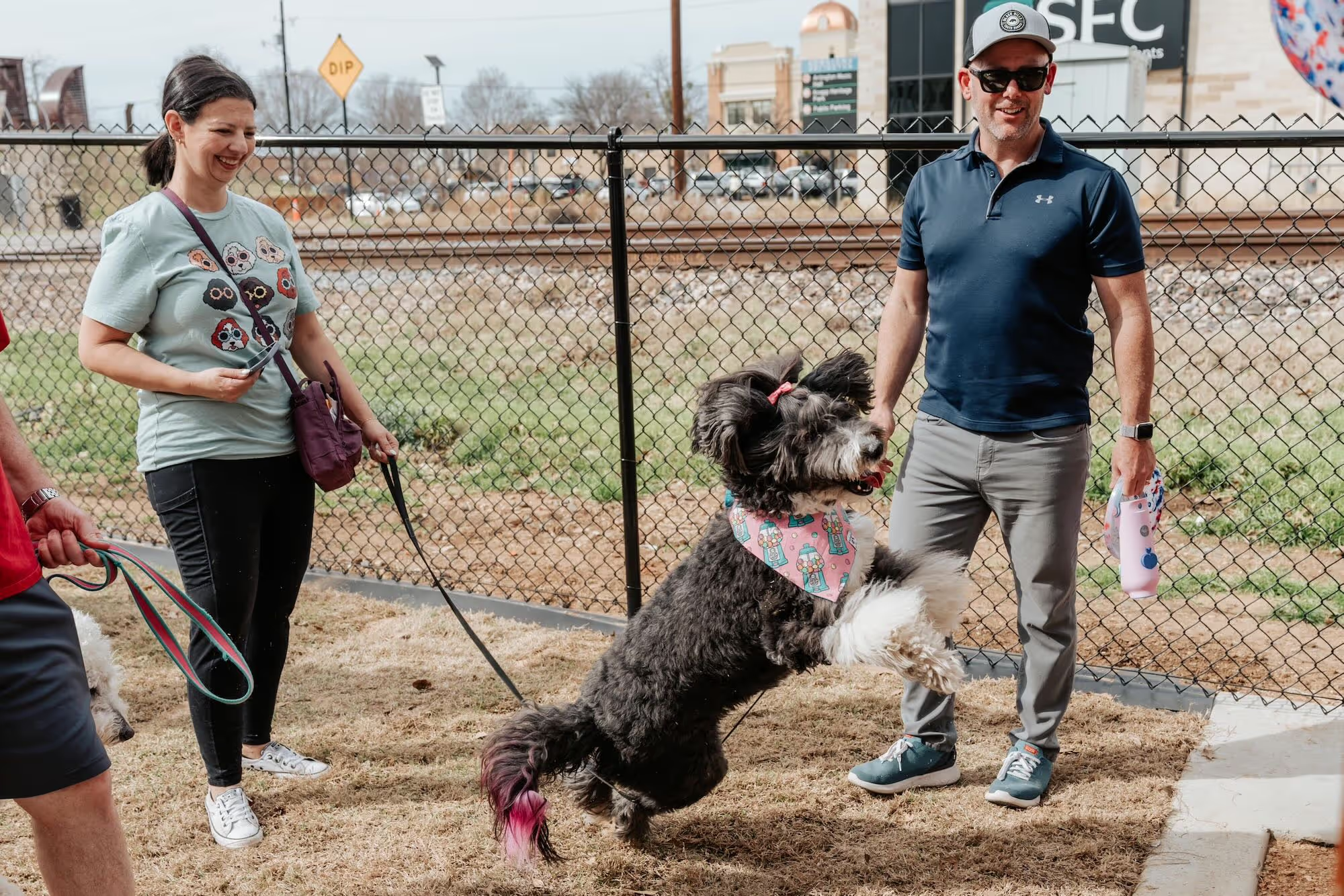
The Doggie Depot’s informal atmosphere is also part of its role as a third place. A setting that doesn’t demand strict dress or formal behavior makes people more likely to leave social divisions aside. In this case, the park invites people to come as they are on a spontaneous dog playdate, a lunch-break walk, or the “Canines and Coffee” meet-ups that have attracted visitors to the space. The space demands only one’s presence and openness to conversation (or a round of fetch).
People keep coming back to a place because of how it makes them feel. Third places must not only fulfill the qualities of a great place—sociable, active, comfortable, and accessible—but also build bonds between people and satisfy the human need for a sense of belonging. But how do we evaluate a third place in action?
To start, long-standing relationships are much more likely to form where there is a regular clientele, so repeat visitors are an important metric of a high-performing third place. Repeated contact begets stronger feelings of trust and familiarity in a community. “Regulars” also add to the character of a space, and very often become invested in maintaining it—crucial elements to sustaining these prized places.

More directly, we can ask people how a space makes them feel, or measure the performance of a place by surveying how inclusive their social interactions are. A questionnaire or survey can reveal how often they share experiences with someone with differing lived experiences or identities to their own. High levels of socio-economic mixing show that a place breaks down boundaries to provide a genuine source of community—a surefire way to spot a real third place.
But these outputs only include the things that are easiest to count. The true benefits of third places can be found in their outcomes and impacts.
What sets third places apart from other community spaces is their ability to connect people across social differences, including across hierarchies and power dynamics. Oldenburg calls this “social leveling.”
That’s not to say that every third place is open to everyone. Many of the examples in Oldenburg’s original book were frequented primarily by men, for example, but they did cut across other lines of class and sometimes race. Other studies of third places have found spaces dedicated to women, queer people, or young people. The point is that third places often create a new community that may defy other typical social divisions. “Affiliations stemming from family membership and employment are not, of themselves, adequate to either community or grass-roots democracy,” as Oldenburg put it. “There must be places in which people can find and sort one another out across the barriers of social difference.”
Third places even go beyond social leveling by creating bridging social capital. Not only do different social groups feel at ease in a third place, but they are also inclined to connect with people from different walks of life. One of the hallmarks of a great place is to make room for encounters that enrich the social lives of those who spend time there, bringing people together who might not otherwise have met.
New York’s Bryant Park, which Project for Public Spaces helped transform in 1980, may be one of the busiest public spaces in the city, but it also harbors a mini-third place: the ping pong tables. People from all kinds of backgrounds, though mostly men, have built relationships through playing at “the tables.” Source: “The Tables” by Jon Bunning on Vimeo
Another frequent phenomenon in third places is that of informal surveillance—or “eyes on the street,” in the words of Jane Jacobs—in which people keep an eye out for one another and address inappropriate or dangerous behaviors in a collaborative way—. This dynamic can contribute to feelings of comfort and safety among regulars, two key ingredients of a great public place.
Finally, people who spend time in a third place often benefit from feelings of psychological support, filling up their social battery through conversation, talking about things they can’t with their family or coworkers, or just enjoying the presence of others around them.
Civic engagement and exchange are crucial elements to building a society that values progress toward the collective good. Especially in an era of political polarization, Oldenburg argued that third places can boost social cohesion and civic conversation.
As social leveling and bridging social capital develop among users, a sense of inclusion begins to emerge. This collective experience signals the success of a true third place. People must feel welcomed, a quality clearly visible at the Shafter Library and Learning Center in Shafter, California. Through a PPS Community Placemaking Grant, the library underwent an expansion between 2019 and 2022, adding new classrooms, a reading room, a maker space, and upgraded outdoor areas that help it to serve double the number of people it previously hosted. Boosted by these improvements, the Center has become an important social hub for the full diversity of the Shafter community. Its class offerings span a wide age range, from frequent storytime events to courses for “adulthood job readiness, literacy, computers, STEM, and skilled trade and vocational education.” Kids can play with Legos in the reading room while older students study; parents can pick up library resources or drop in on baking classes. And between all of this programming is the hangout time and casual conversation that makes it more than the sum of its parts as a third place.

Social connection is another obvious benefit of third places. Not only do third places help us to better connect with our friends and meet new casual acquaintances, but they also instigate useful “social friction.” This phenomenon encourages us to get out of our comfort zone, encounter new ideas, and share a space with people whose points of view may differ from our own. It is the resulting informal conversations that might help us to get out of our usual social bubbles, build shared trust, and find a sense of common ground. Social friction is not always comfortable, but is necessary in a society that meaningfully grows out of a diversity of opinions and lived experiences. This phenomenon is summed up well in a viral social media post by Divya Venn, stating, “Annoyance is the price you pay for community.”
The result of this social infrastructure is the type of self-organization that makes our communities more resilient. According to Oldenburg, third places ”serve as ‘sorting areas’” that help people to meet one another and share “skills, abilities, and attitudes” that might contribute to shared goals for the community, often in unpredictable ways. Unless we do the work of getting to know one another, we may never find out what we can accomplish collectively. As researcher Eric Klinenberg has observed, communities that have strong social ties supported by the places they share fare better in disasters, like heat waves, hurricanes, pandemics, and beyond.
An enhanced sense of community for all also means improved health and well-being at the individual level. Part of our shared antidote to loneliness, third places are increasingly considered to be beneficial—and not only for interpersonal relationships. According to the U.S. Surgeon General’s advisory addressing the loneliness epidemic, social connection and community have healing effects. Research has shown that communities with stronger social connections experience lower disease burden and mortality This sense of community can significantly improve the likelihood that people report good health and live longer.
In short, the seemingly simple conversations that happen in the places we visit regularly between work and home can have a tremendous impact on society. From our heart health to the health of our democracy to surviving climate change, third places matter.
Despite their decline, people are not ready to give up on these vital places. As Oldenburg and his collaborator Karen Christensen co-wrote in a 2023 update, “The third place is at the center of our search for a better way to live.” There remains a gap for everyday places that reliably provide us meaningful interactions with other people in our community.
Paradoxically, we need more third places, but they cannot be created quickly from scratch—their success is dependent on who inhabits them and how. What’s more, our historic reliance on for-profit third places takes time to build up organically. “Newer places are more wedded to the purposes for which they were built,” wrote Oldenburg. “Maximum profits are expected … [and they] also tend to emerge in prime locations with the expectation of capitalizing on a high volume of transient customers.” This means that finding our way back to more plentiful third places isn’t going to be as simple as building more chain coffee shops—and it certainly won’t be accomplished by one corporation alone.
We must not only preserve existing third places, but also embed third place principles into public spaces and establishments whenever possible. In the UK, campaigns like “Pub is the Hub” are working to support pubs in providing social value to their communities. At the same time, third places are being reinvented or taking new shapes. Groups that practice their hobbies in place encourage conversation while partaking in pottery or knitting or rock climbing gyms or screen printing. Meanwhile, for better or worse, digital third places are often meeting this demand; although the actual benefits are highly dependent on users’ interactions, online games and chatrooms can be a source of repeated connections. Organizations like New_Public are striving to create online places that serve these purposes, while combating the most toxic tendencies of the internet.

Nonprofits can also be a part of the solution. With support from the Robert Wood Johnson Foundation, Project for Public Spaces is currently partnering with CultureHouse on Community Placemaking Grants that have been used to create pop-up civic spaces in BIPOC and low-income communities. Third places can be fostered and sustained when place-based nonprofits have access to resources and capacity-building support. These organizations are particularly well-positioned to take this on, as they often have an ear to the ground in terms of what a community needs, and can provide access to resources in addition to meaningful social and civic connection.
Aaron Greiner, Executive Director of CultureHouse, notes that, while municipalities should fund third places as a public good, nonprofits are well-suited to stewarding third places. “With a mission geared towards serving community members,” says Greiner, “nonprofit third places can pick up where local government leaves off—without requiring a significant barrier to entry.” Through targeted partnerships, nonprofits can help bridge the gap in third places, and help us mend our damaged social ties.
The benefits of third places are clear. Without them, our lives lose the richness of diverse social encounters, repeated hangouts, and the benefits that these bring to our health and democracy. Now, we need to protect and cultivate our third places—like our social lives depend on it.
The rich text element allows you to create and format headings, paragraphs, blockquotes, images, and video all in one place instead of having to add and format them individually. Just double-click and easily create content.
The rich text element allows you to create and format headings, paragraphs, blockquotes, images, and video all in one place instead of having to add and format them individually. Just double-click and easily create content.
Body Text Body Link
The rich text element allows you to create and format headings, paragraphs, blockquotes, images, and video all in one place instead of having to add and format them individually. Just double-click and easily create content.
Here is some highlighted text from the article.

Headings, paragraphs, blockquotes, figures, images, and figure captions can all be styled after a class is added to the rich text element using the "When inside of" nested selector system.
Headings, paragraphs, blockquotes, figures, images, and figure captions can all be styled after a class is added to the rich text element using the "When inside of" nested selector system.
Headings, paragraphs, blockquotes, figures, images, and figure captions can all be styled after a class is added to the rich text element using the "When inside of" nested selector system.

We are committed to access to quality content that advances the placemaking cause—and your support makes that possible. If this article informed, inspired, or helped you, please consider making a quick donation. Every contribution helps!
Project for Public Spaces is a 501(c)(3) tax-exempt organization and your donation is tax-deductible within the guidelines of U.S. law.

.avif)