Close Menu
Menu
“I’m beyond thrilled to partner with Project for Public Spaces to create a civic sanctuary for Black people and our allies. In the right space, we remember who we are, see our shared humanity more clearly, and chart a path forward where we all win. We need this now more than ever.”—Shanna Sabio, GrowHouse’s Co-Founder & Co-Director
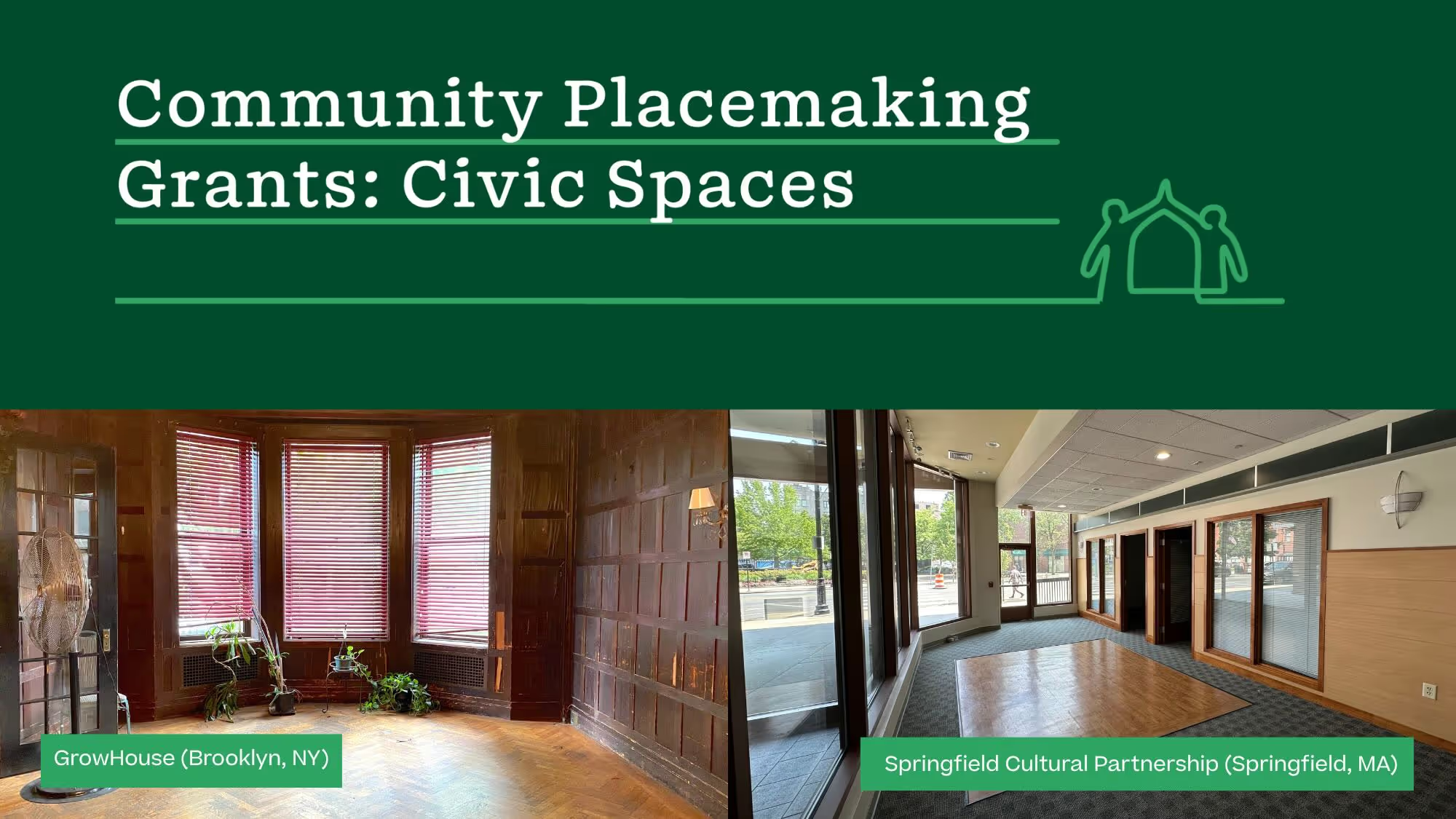
As part of Project for Public Spaces’ Community Placemaking Grants: Civic Spaces, an initiative supported by the Robert Wood Johnson Foundation, GrowHouse NYC, a community design and development cooperative, received $60,000 to transform a vacant 900-square-foot storefront in Bed-Stuy, Brooklyn, into a gathering space for civic engagement, a classroom for commonwealth learning, a design lab for cultural and economic infrastructure, and more. By anchoring people in this space, this civic pop-up tackled multiple challenges: deficiency of civic infrastructure, the urgent need to cultivate community leadership, and the deeper work of confronting systemic inequality and forging resilience within the BIPOC community in Bed-Stuy.

As one of two nonprofit grantees in this civic space-focused initiative, GrowHouse received the direct funding for planning, implementation, and capacity building assistance from Project for Public Spaces and CultureHouse, a nonprofit that specializes in community pop-ups. The initiative's roots run deep in a neighborhood whose cultural legacy makes this work especially urgent: once home to one of the largest Black communities in the U.S. since the 1930s, Brooklyn's Bed-Stuy neighborhood has seen its BIPOC population steadily decline in recent decades due to gentrification and displacement.
In fact, a key shift occurred mid-project due to these rapidly changing dynamics in the area. A court-ordered sale evicted and displaced local organizations, including GrowHouse, that were operating out of the historic People's Mansion at 375 Stuyvesant Avenue, the original site for GrowHouse’s civic space. Also known as Stuyvesant Mansion, the building was formerly owned by the late Dr. Josephine English, New York State’s first licensed Black female gynecologist to have a private practice. As the organization looked for alternative sites for their space, GrowHouse Co-Founder Shanna Sabio, remained committed to the People’s Mansion and helped lead the establishment of the BLAC Land Trust as an investment vehicle to establish community ownership of the building before it is sold to a private buyer.
Meanwhile, as a result of the displacement, GrowHouse pivoted to rent and transform a 900-square-foot storefront on Marcus Garvey Boulevard, as the project’s new civic space. With land ownership and stewardship being a central focus of GrowHouse’s work, the space being part of a Black woman-owned building was a highlight. “It felt really good to be able to support a Black woman owner with the funds from this grant,” Shanna shared.
GrowHouse hosted visioning sessions with the local community, selected a site for activation, conceptualized a design, and made space improvements in preparation for implementing programs and a charted plan for future activations. Through events like block parties, site tours, and pop-ups, GrowHouse engaged a diverse mix of legacy residents, technical experts, elders, and youth while collecting stories and insights to inform future programming. The feedback pointed to the need for intergenerational learning, land stewardship, and grassroots organizing to resist cultural erasure and strengthen community resilience.
After months of planning with the community, designing, and renovation, GrowHouse opened the door to its civic space in February 2026. The civic sanctuary reflected the expressed needs of the local community. It included:

The pop-up was supported by the grant through May 2026. GrowHouse was able to secure a one-year lease for their space after the pop-up. Looking ahead, it is hoping to expand youth engagement through school partnerships, host events to deepen community roots, and test revenue models like co-working and makerspace programming to help sustain the necessary funding to keep the space open as a resource for the neighborhood.
Learn more about Project for Public Spaces’ Community Placemaking Grants.
Follow GrowHouse on Instagram.
Project for Public Spaces thanks our Social Impact Partner Robert Wood Johnson Foundation, whose support helps make this work possible.

Project for Public Spaces’ Community Placemaking Grants enable US-based nonprofits and government agencies to address inequality of access to public places that serve community needs by working directly with local stakeholders to transform spaces or co-create new ones. We do this by providing direct funding, technical assistance, and capacity building facilitated by Project for Public Spaces. Learn more about how to become a Social Impact Partner today.
You can also support our work by making a donation. Every bit helps to bring public spaces to life!