Close Menu
Menu
What is a public market worth? Ask a room full of experts this question and the answers could be as diverse as the products displayed in a busy market hall on Saturday morning.
Public markets offer a range of interconnected economic, civic, and environmental benefits to consumers, producers, and communities alike. But that complexity presents a unique challenge: how to tell the full story of public markets’ value in a way that is compelling, complete, and—in a world where attention is an increasingly scarce commodity—concise.
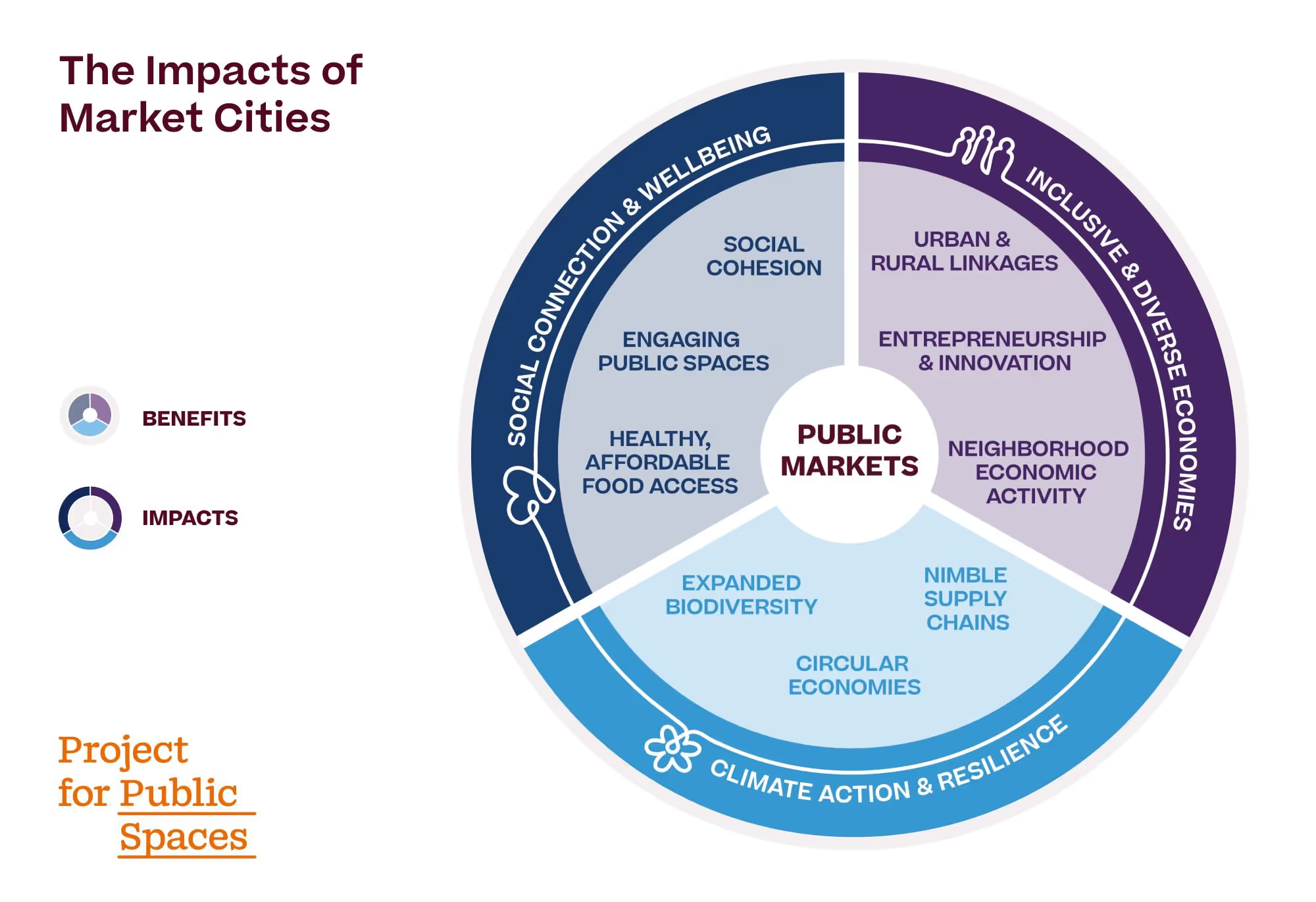
The Impacts of Market Cities diagram and associated framework (figure above) tackles that challenge by illustrating how the broad spectrum of benefits that markets generate work in concert to create stronger cities and towns. Created in collaboration with members of the Market Cities Network’s policy affinity group, the need for such a framework came from conversations with leaders across the country who said this was a gap when it comes to increasing investment in public markets. Markets are valuable community infrastructure, and this new framework will help advocates demonstrate the role markets can and already do play in achieving local community goals.
This article is the first in a series that will explore the three major impact areas identified in the framework, looking first at the role markets play in building Inclusive & Diverse Economies.
A market is a place of commerce, so it’s no surprise that its most clearly articulated benefits are often about dollars and cents. Numbers carry weight, and market operators are getting better and better at demonstrating how markets are already generating significant economic impact. From new local businesses created and jobs supported, to sales and local tax revenues generated, there is no shortage of persuasive data that markets can highlight to demonstrate value to their communities.
But understanding how these numbers relate to harder-to-measure intangible benefits can be the difference between decision-makers seeing a market as nice-to-have or as absolutely essential. Beyond traditional indicators, public markets are so beneficial to local economies because they change the ways people engage in commerce—it’s not just about the volume of buying and selling.

In the following case studies that span cities and regions, we explore three key benefits of markets as economic engines, and how they have played out in different communities: Entrepreneurship & Innovation, Urban & Rural Linkages, and Neighborhood Economic Activity.
Markets are destinations in and of themselves, making them ideal launchpads for entrepreneurs. Steady foot traffic allows early-stage businesses to try new things, take risks, innovate, and evolve quickly as they learn more about what customers are looking for through face-to-face interaction. As a result, it is not uncommon for contemporary markets to operate incubator kitchens to provide additional assistance to new vendors. What’s less common is for it to happen the other way around.

Located along historic Route 66, Tulsa, Oklahoma’s Mother Road Market has grown into a bustling community hub since it was created eight years ago by the founders of Kitchen 66, the self-described “kickstart kitchen” managed by the Lobeck Taylor Family Foundation. “Before the market even existed,” explains Chief Program Officer Charlie Love, “our founder had tried to start her own cupcake business. As she set about doing that, she realized how difficult it was to get [a small business] going. Her passion then became breaking down those barriers for other people.”
Initially, Kitchen 66 focused on providing affordable commercial kitchen space for food entrepreneurs on a membership basis. Soon enough, the incubator began to generate a steady stream of new businesses looking for an affordable way to establish a brick-and-mortar presence. This inspired the creation of Mother Road Market, a food hall with 13 stalls for long-term tenants, along with two temporary spaces that provide single-day (Takeover Cafe) and week-long (Residency Cafe) pop-ups for Kitchen 66 businesses on a rotating basis. This mixed model allows entrepreneurs at different stages to try out new ideas as they grow within a familiar and supportive space. As of 2025, 90 unique businesses have popped up through the Takeover Cafe, Residency Cafe and other venues.
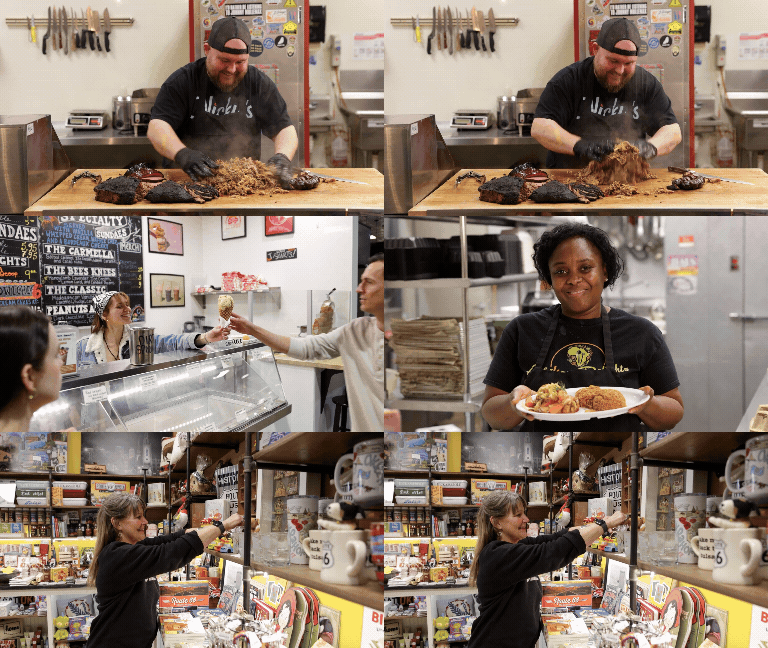
Initial leases at the market run for three years, with an option to renew for an additional three—so the market is understood to be temporary from the get-go. As businesses spin off to their own locations beyond the market, space opens up for new entrepreneurial endeavors from Kitchen 66 tenants, where the cohort-based Launch Program (and its Spanish-language counterpart Programa de Lanzamiento), a kind of “entrepreneurship 101” crash course, keeps the pipeline flowing. The program has graduated 267 new entrepreneurs since it started.
“When other food halls come down to study our model,” Love notes, “they’re learning that Kitchen 66 is really the heartbeat that’s pumping to keep the market alive.”
The market also creates an intentional community of entrepreneurs, where new tenants and pop-up hosts can learn from businesses a few years ahead of them in the process of building a following and navigating the ins and outs of staffing, licensing, pricing, and more. Love and her team work to foster that sense of community, tapping into the sense of friendly competition that merchants feel with their peers by organizing annual "Food Fights" where businesses can showcase their dishes and compete for prizes—further encouraging participants to test out new ideas.
“I think [the market’s success demonstrates] the power of the collective, in that there’s all of these different things here,” says Love. “You’re not a one-man band that has to rely solely on yourself to drive your own customer base.”
Supportive market staff, friendly competition and camaraderie with fellow vendors, and access to regular customers create ideal conditions for entrepreneurs to find their footing and innovate. Mother Road Market shows how formalized business incubation support can amplify what markets naturally provide, expanding the launchpad into a full runway.
So much of shopping nowadays takes place online or at large chain stores, where the experience is impersonal and convenience is king. A trip to the farmers market, by contrast, is a social affair that strengthens regional connections by bringing urban dwellers and rural producers together. As places where buyers and sellers meet face to face, markets have a unique capacity for connecting people from very different walks of life, strengthening regional connections and identity.
Fondazione Campagna Amica, a network of farmers markets created by the Italian agricultural union Coldiretti, has seen phenomenal success in building these connections. Launched in 2008, they now operate 1,200 markets nationwide, generating an annual turnover of around four billion euros. As is always true of great public spaces, their markets are all about people, and the interactions between them.
.avif)
“When Campagna Amica was created, it was born from an idea of Coldiretti to try to give another option to consumers,” explains Giulia Maggi of the World Farmers Markets Coalition (which Campagna Amica helped launch and now leads). The aim is not just to improve access to more nutritious food, “but also to create a link between the producer and consumer.”
As a group representing the interests of independent farmers, Coldiretti was well-positioned to establish a network of local markets by bringing its members together. Campagna Amica offers a range of technical and administrative services to vendors who sell at their markets, along with a robust promotional strategy to ensure steady foot traffic from an enthusiastic customer base. The markets feature a strong, unified aesthetic, creating a recognizable presence that can compete in an environment crowded by large corporate retailers with slick branding. The foundation describes its network as “capillary,” with individual markets supported by 20 local regional coordinators, in turn supported by a strong central organization.
.avif)
This approach, according to Maggi, allows producers to be seen “not as isolated individuals, but as part of a strong, structured network that operates consistently across the territory and builds lasting relationships with consumers.” By selling at Campagna Amica’s markets, rural producers gain direct access to a density of city customers and steady sales volumes, which helps make the economics of rural farming and small-scale production more viable.
Above and beyond strictly economic outcomes, Campagna Amica’s markets help people see each other as members of the same regional community. When urban-rural connections weaken, something vital is lost. “What you lose is a kind of existential sense of place,” says WFMC President Richard McCarthy. “If it doesn’t matter where you go, and you can get the same products everywhere, you lose that sense of ‘I belong to a place, and I’m part of this place.’” Without a shared connection to place, people divide along other lines—city versus country, us versus them. “The importance [of public markets] is you can begin to rebuild the social contract.”
In a world where commerce has become faceless and placeless, Campagna Amica’s markets are living proof that markets can bring people together to strengthen the social fabric of a region as well as sustain local economies.
The colocation of a wide variety of small businesses at a market creates a sense of bustle that spills over into the surrounding streets, generating activity from the early morning arrival of vendors to the evening revelry of diners at restaurants and bars that often sprout up nearby. By strengthening the local sense of place and drawing in regular customers and tourists alike, markets can have a transformative impact on the economic character of whole neighborhoods.
Historic Findlay Market, built in 1852 on what was then the edge of Cincinnati, Ohio, has the feel of a place so embedded in its community that it’s hard to imagine a time when it didn’t exist. Owned by the city but managed by the independent nonprofit Corporation for Findlay Market (CFFM), the market has become an economic anchor institution in the historic Over-the-Rhine neighborhood, establishing the district as a hub for jobs and driving commercial investment and new development. Local developers and community leaders have taken notice of the market’s success and impact and now see CFFM as a go-to resource when looking to fill new or vacant commercial spaces in Over-the-Rhine—and across the city.

When City Hall identified the need for a shared commercial kitchen as part of a strategic economic plan, Findlay Market was identified as the ideal location. Since Findlay Kitchen launched in 2016, CFFM has developed a pipeline of strong local businesses ready to fill vacant spaces, similar to the impact of Mother Road Market in Tulsa. Building on that success, CFFM identified additional opportunities to support entrepreneurs and created Findlay Learn and Findlay Launch in 2021. These programs help aspiring tenants learn business basics and test retail concepts before committing to brick-and-mortar locations. “All of the programs have built on each other,” says Kelly Lanser, CFFM’s President & CEO. “[We’re listening, hearing the struggles,] and just trying to find answers to the questions that people have.”
They seem to be onto something: Findlay Kitchen has supported more than 300 businesses since its inception, while 147 have completed Findlay Learn and Findlay Launch. And a whopping 42.9% of Findlay Market’s vendors have expanded since opening at the market.

As a food destination, Findlay Market has become a major driver of the surrounding neighborhood’s revitalization. A recent report found that the market had generated $370 million in total economic impact over a three-year period. The area immediately surrounding the market had seen over $505 million in capital investment across 53 developments, leading to almost $600 million in indirect economic impact, for a total economic impact exceeding $1.1 billion. While many factors played into this growth, the market played an important and under-appreciated role.
“That was something that we always thought to be true, but when you look at [the map of capital investment], it is obviously true,” says Lanser. “It’s clear that’s the case in Cincinnati, but when we talk about the role of public markets, of supporting small businesses in other cities, and why they matter, that’s it.
“People care about shopping local, they care about small businesses. People want walkable communities, they want spaces where placemaking is top of mind, where people feel like they’re part of the community. It’s a reminder that relationships matter. You shop at a public market and you can’t buy something without talking to someone. That’s just so different from so much of what people’s daily lives have become. It’s a reminder of what people actually care about.”
Findlay Market’s story is a testament to how a market, rooted in its community and committed to supporting its local businesses, can spur economic growth that lifts up an entire neighborhood.
–
Public markets deliver value that goes far beyond commerce and is difficult to capture through conventional metrics alone. As these examples show, public markets are powerful platforms for building inclusive and diverse economies—supporting entrepreneurial innovation, strengthening regional links between city and country, and anchoring neighborhood commercial life.
As we continue our series on the Impacts of Market Cities over the next year, we’ll explore two other impacts of the framework: how markets support Climate Action & Resilience and foster Social Connection & Wellbeing. Taken together, we hope this work equips market leaders to tell the story of what markets do and why it matters.
The rich text element allows you to create and format headings, paragraphs, blockquotes, images, and video all in one place instead of having to add and format them individually. Just double-click and easily create content.
The rich text element allows you to create and format headings, paragraphs, blockquotes, images, and video all in one place instead of having to add and format them individually. Just double-click and easily create content.
Body Text Body Link
The rich text element allows you to create and format headings, paragraphs, blockquotes, images, and video all in one place instead of having to add and format them individually. Just double-click and easily create content.
Here is some highlighted text from the article.

Headings, paragraphs, blockquotes, figures, images, and figure captions can all be styled after a class is added to the rich text element using the "When inside of" nested selector system.
Headings, paragraphs, blockquotes, figures, images, and figure captions can all be styled after a class is added to the rich text element using the "When inside of" nested selector system.
Headings, paragraphs, blockquotes, figures, images, and figure captions can all be styled after a class is added to the rich text element using the "When inside of" nested selector system.

We are committed to access to quality content that advances the placemaking cause—and your support makes that possible. If this article informed, inspired, or helped you, please consider making a quick donation. Every contribution helps!
Project for Public Spaces is a 501(c)(3) tax-exempt organization and your donation is tax-deductible within the guidelines of U.S. law.