The Placemaking Round-Up
A biweekly newsletter with public space news, resources, and opportunities.
The Biweekly Bazaar
A curated dispatch on all things public markets plus the latest announcements from the Market Cities Program.
A biweekly newsletter with public space news, resources, and opportunities.
A curated dispatch on all things public markets plus the latest announcements from the Market Cities Program.
Editor’s Note: Paige Hammond, a community builder in Shorewood, Wisconsin, began inviting women to her backyard sauna as a way to establish genuine human connection among her neighbors. What started as a simple invitation on Facebook grew into the Shorewood Women's Social, a network of low-pressure, in-person gatherings held across the neighborhood in both public and private spaces. Her experience taught her that community doesn't require institutional planning—it just takes one person willing to open their door and others willing to walk through it. At Project for Public Spaces, we had the honor of working with Paige, who is the Marketing & Communications Manager at Milwaukee Public Market, which was the co-host of the 12th International Public Markets Conference in Milwaukee, Wisconsin in 2025.
Humans need third places that foster connection and strengthen communities. After welcoming nearly 100 strangers into the sauna in my backyard, I realized we don’t need to wait for institutions to provide it to us.
I’m fortunate that community building is part of my professional life, and I’ve found real fulfillment in it. I wanted to bring that same energy and mindset into my volunteer work in my own neighborhood. I serve on the Parks & Public Spaces Committee in Shorewood, the most densely populated municipality in Wisconsin, located just north of Milwaukee.
I often left those meetings defeated. When you’re working within committees, budgets, and competing priorities, progress can feel slow. Ideas get discussed more than they get tested, and the impact can feel far removed from everyday life.
Around the same time, something else was happening in my own backyard.
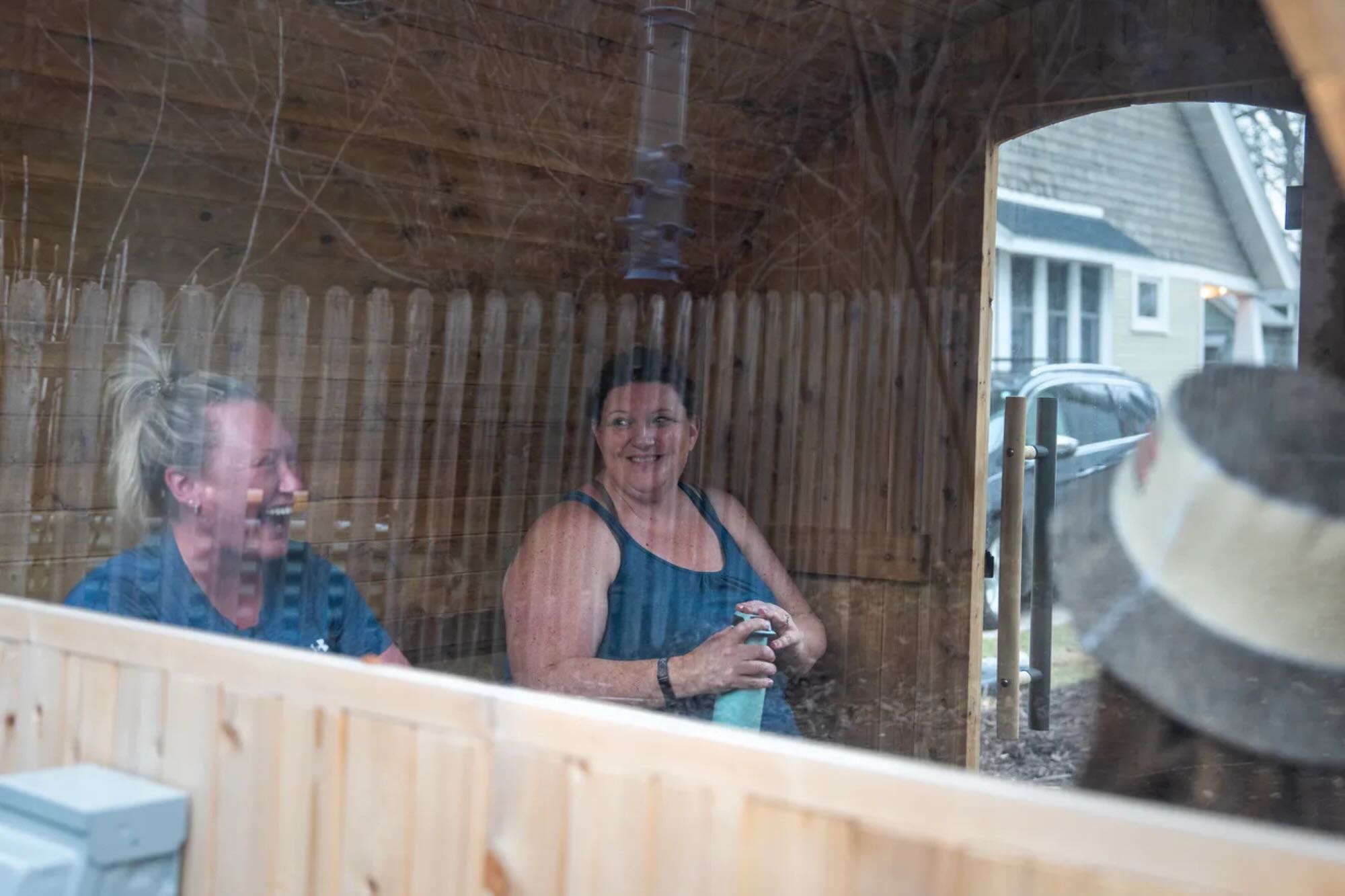
A trip to Finland, paired with a growing sauna culture in Milwaukee, inspired me to install a sauna at home. With Finnish ancestry, I’ll often joke that once I experienced a true sauna, it felt like something I had been missing my entire life. But when I finally had one of my own, I realized something else was missing: people.
At places like Löyly in Helsinki or Hot Spell Sauna and The Hive in Milwaukee, the experience goes far beyond the heat. Sauna, for me, had become deeply social. It was about conversation, shared space, and slowing down together. Sitting alone in my backyard, that part was gone.
That changed in February, when it occurred to me I could invite others to join me.

I used an existing Facebook group and simply asked if any women were interested. Within hours, the post had more than 100 comments from women who were just as excited about the prospect of meeting others as I was.
It quickly became clear that something much bigger than my backyard sauna was unfolding. Comments like, “I am so excited to meet all of you! We need more powerful women in our lives,” and “Am I about to make friends as an adult? This seems magical,” started rolling in.
Now, what started as a few sauna sessions per week has grown into gatherings happening across the neighborhood, in both public and private spaces. Some are hosted by me, and some, like the recent addition of sing-alongs in a neighbor’s home, are hosted by others.
All Shorewood Women’s Social gatherings share the same goal: low-pressure, real-life gatherings that turn neighbors from strangers into friends.
Here’s what I’ve learned:
Conversations usually begin lightly, but they don’t stay there. They naturally evolve into deeper discussions about family, philosophy, health, and the ways systems don’t always serve us. You can feel the power of the collective in those moments.
As women leave, often after hugging or exchanging contact information, we hear the same thing again and again: “This is healing.”
I used to think community needed to be built through planning and systems, but most communities already have the physical and social infrastructure needed for connection. Now I’ve realized, individuals don’t need permission to socially activate the spaces that already belong to us.

Through social media, we’re connected to over 60% of the world’s population, yet research shows most Americans know only some or none of their neighbors. At the same time, social media use is associated with increased loneliness, while strong, in-person relationships are tied to better mental health.
“I feel empowered being surrounded by so many strong women.”
—a sauna night participant
At these gatherings, screens are put away. We’re remembering what it feels like to truly connect, human to human.
Shorewood itself is just 1.5 square miles, and if you consider yourself part of this community, whether you live here, work here, or simply feel connected, you’re welcome to join a gathering.
That proximity matters. It’s the small, repeated moments that build relationships over time. Seeing the same people on a walk, in a park, or at a gathering. Familiarity grows, and that’s what turns a place into something that actually feels like a community.
In Shorewood, I’ve seen it happening in real time.
Angie has walked her beagles past Abigail’s house for years, but it wasn’t until they met at a sauna session that they realized they had crossed each other’s paths countless times.
Now, instead of passing each other on the sidewalk as strangers, they stop and connect.
Research shows that cost, time, and social pressure are major barriers to participation in community life. When something feels complicated or high-effort, people opt out.
Our gatherings are intentionally approachable. No one is expected to contribute anything beyond their presence and everyone arrives on equal footing. It shifts the mindset from “I can’t go, I don’t know anyone” to “I’ll go because no one knows anyone.”
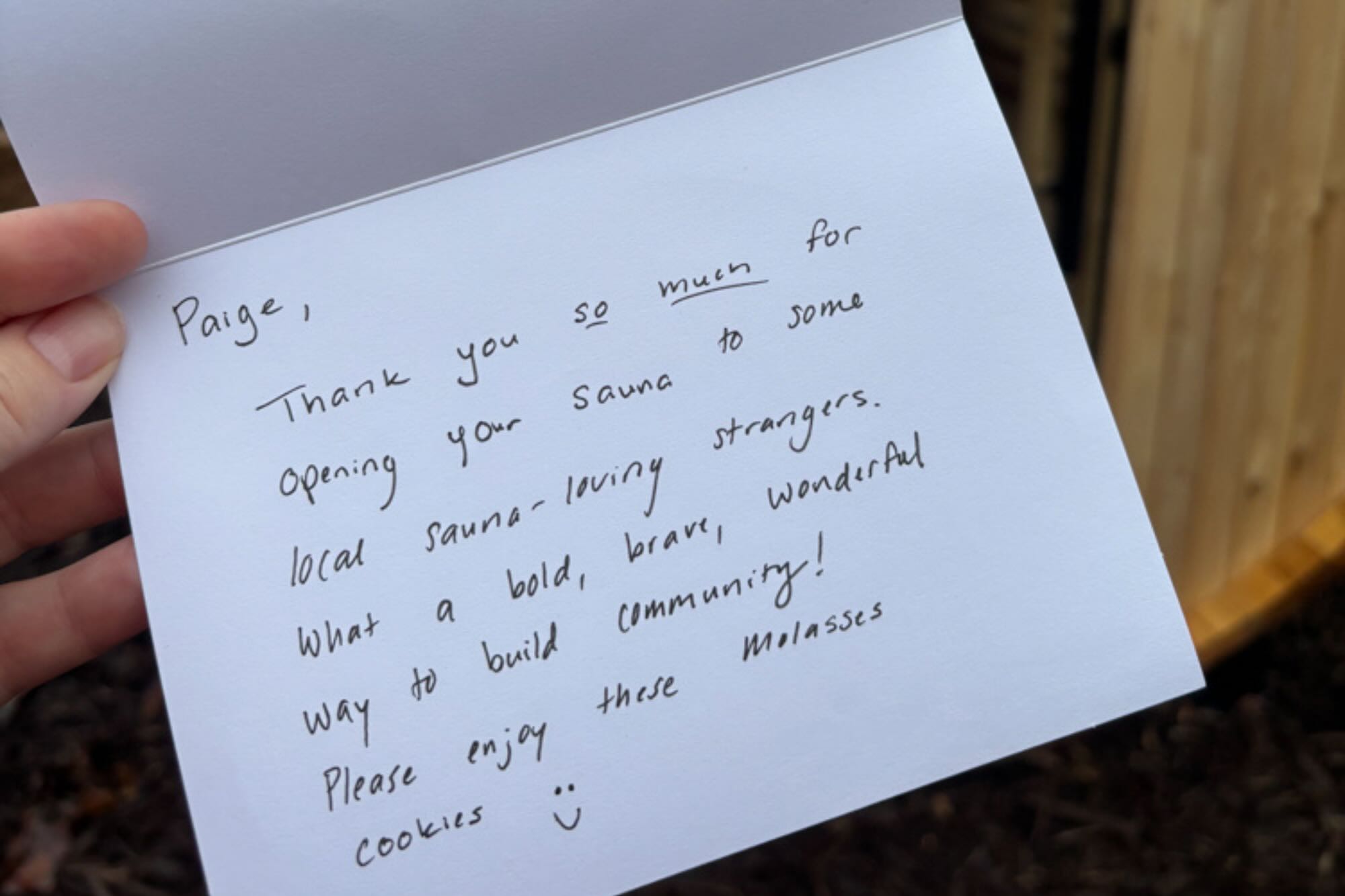
Interestingly, that doesn’t mean people aren’t contributing.
The first time I hosted, I had provided only the sauna. One woman brought peppermint tea and mugs, and another brought molasses cookies, for everyone to share. Someone else offered guided breathwork. None of it was expected, but it happened anyway.
Socialization often occurs within groups where people look like us, think like us, or are in the same stage of life. There’s nothing inherently wrong with that, but when diverse social networks are linked to greater empathy, stronger communities, and more resilience, we limit ourselves when we keep our circles closed.
Shorewood gatherings have brought together people who might not otherwise have crossed paths. Different ages, backgrounds, and experiences. The only shared factor is a connection to this place.
The biggest shift didn’t happen at the first gathering. It happened the first time it wasn’t mine.
I remember walking away from a stranger’s home in the dark that night, almost in disbelief. Just a few weeks earlier, everything had been contained to my backyard.
Earlier that evening, eleven women had met at a community park for a walk. I stayed back for a moment at the end, just watching. The sound of conversation carried as people lingered, exchanging numbers, continuing conversations that didn’t seem ready to end.
From there, I went to a second gathering. For the first time, I wasn’t the host. I had never met the women opening their home, but we used the platform I had built to invite other strangers to join.
They welcomed everyone in with drinks, cookies, and name tags, then sat down behind a piano and a guitar and led a room of strangers through a full sing-along.
Like sweating in a sauna, pretense fell almost immediately. Women joined together and sang loudly and without hesitation. By the end of the night, women who had met just hours earlier were hugging goodbye like they had known each other for years.
I walked out of that house with the strongest sense of purpose I’ve ever felt: the value this was providing to women in my community was bigger than me, and it needed to keep growing.
Once someone experiences what this feels like, the barrier lowers and the idea of creating it themselves becomes less intimidating. In addition to more sauna sessions, sing-alongs and park gatherings planned, we already have more women preparing to host gatherings of their own.
I still believe deeply in the work being done through institutions (and that we need to push for much more of it), but this has changed how I think about where community begins. By someone deciding to open their door, and others willing to walk through it. If it sounds simple, it’s because it is.
—
By day, Paige Hammond is the Marketing & Communications Manager at the Milwaukee Public Market, where she focuses on storytelling, partnerships, and building community at scale. Outside of her work, she has spent time volunteering to support local community initiatives. Across her work and everyday life, she takes a people-first approach, grounded in the belief that strong communities are built through connection.
The rich text element allows you to create and format headings, paragraphs, blockquotes, images, and video all in one place instead of having to add and format them individually. Just double-click and easily create content.
The rich text element allows you to create and format headings, paragraphs, blockquotes, images, and video all in one place instead of having to add and format them individually. Just double-click and easily create content.
Body Text Body Link
The rich text element allows you to create and format headings, paragraphs, blockquotes, images, and video all in one place instead of having to add and format them individually. Just double-click and easily create content.
Here is some highlighted text from the article.

Headings, paragraphs, blockquotes, figures, images, and figure captions can all be styled after a class is added to the rich text element using the "When inside of" nested selector system.
Headings, paragraphs, blockquotes, figures, images, and figure captions can all be styled after a class is added to the rich text element using the "When inside of" nested selector system.
Headings, paragraphs, blockquotes, figures, images, and figure captions can all be styled after a class is added to the rich text element using the "When inside of" nested selector system.

We are committed to access to quality content that advances the placemaking cause—and your support makes that possible. If this article informed, inspired, or helped you, please consider making a quick donation. Every contribution helps!
Project for Public Spaces is a 501(c)(3) tax-exempt organization and your donation is tax-deductible within the guidelines of U.S. law.
.avif)