Close Menu
Menu
This article was first published in the Practice of Place Substack. Republished with permission.
By Max Musicant and Shina Shayesteh
We find ourselves in a political era where language is being weaponized. Leaders are saying the exact opposite happened from what we are directly experiencing. “Truth” is becoming more and more the opinion you can yell the loudest.
Our extreme circumstances reveal something that has always been true: language matters. The words we use and the meanings they hold are often the kernels that shape behaviors, our surroundings and our collective life.
And into this wake, we pronounce that placemaking is dead.
Well, at least, the term “placemaking” is.
The truth is that placemaking is a victim of its own popularity: people have begun to recognize its importance as an approach and a need. This is the first complication. We have collectively identified that we need better places, that so much of our modern defaults are not very good. But we don’t have a common understanding or agreement about what makes a sense of place, even though we all want it. Into this void enters the catch-all term “placemaking,” which can now refer to an action, a process, an outcome or a project toward an undefined end by different people at different times.
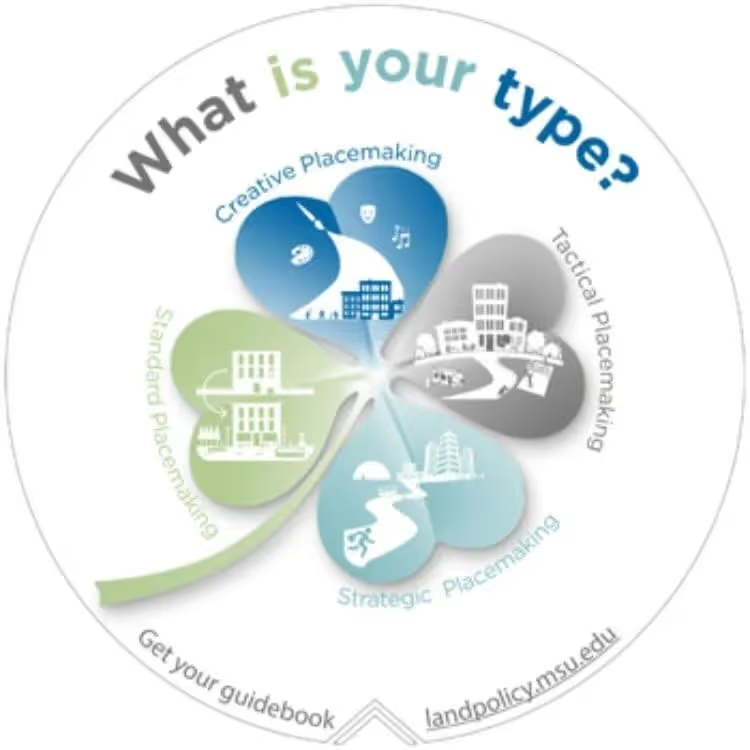
Like so many other concepts that become buzzwords (often due in part to some real success and value), and then get used ad nauseum, “placemaking” has lost most of its functional meaning. When a once-specific concept starts to require qualifiers like “standard placemaking, “strategic placemaking, “creative placemaking,” “tactical placemaking,” or “placekeeping” to know what someone’s even talking about anymore, you know we’ve lost our way.
This lack of consensus has led to three major problems.
1. The vagueness of the term “placemaking” causes confusion between the web of professionals and community members who are involved in creating, stewarding and improving our places.
“We’re going to do some placemaking elements here.” Huh? What does that mean? Public art? Landscaping? Seating? Food options? “Placemaking” gets thrown around as an identifier for one-time actions that are now seen as “creating a place” or “a sense of place.”
At best, such language indicates siloed thinking, that the mere presence of an object we like is going to create a good “place,” even though we don’t have a shared understanding about what that even means. Worse, it can be the equivalent of putting lipstick on a pig, a token effort, to try and attach something nice onto something that is mostly ugly or unpleasant. At its worst, such words can indicate a deliberately exclusionary strategy of creating signals to attract the wealthy without care (or with actual intent) to displace existing patrons.
2. The success of efforts under the banner of the term “placemaking” has led to it becoming a fundable priority.
Well-intentioned foundations and governments jump onboard to grant money for placemaking projects in an effort to improve the communities they care about. So naturally, people, orgs and cities who need financial support for their work contort existing efforts to be framed as placemaking. Sometimes they’re not wrong that what they’re doing could contribute toward improving a place (that is, it could be a part of a larger, more holistic placemaking effort), but nonetheless, the consequence is that “placemaking” has gotten attached to many different types of efforts and projects that aren’t necessarily making places stronger or better, which of course dilutes the meaning of the term. Other worthy concepts like “sustainability,” “equity” and “resilience” have suffered the same fate.
As a result, unsuspecting communities, clients and professionals alike can think they are getting something much better and more impactful than what really materializes, and they wind up being disappointed.
3. Placemaking has gone from a verb to a noun, turning an approach into a thing.
Placemaking at its best is a lens through which any activity relating to the built environment can (and should) pass through. Construction, operations or events can all be place-making, or place destroying. Nothing is inherently good or bad. Placemaking describes an approach with positive outcomes.
But with “placemaking” becoming ever more confined to grant-funded and project-based efforts, “placemaking” ends up being one-shot additions; single events; or short-lived, dead-end pilots. With no mechanisms for continuation, the chance of those efforts having lasting impact is low. Unsuspecting communities, clients and professionals alike are led to believe they are getting something much better and more impactful than what really materializes, and the results are disappointing.
So, we have had a lot of people trying to make places better, but often without success because of bad assumptions about what placemaking can and should be. The proliferation of qualifiers we’re seeing for the term is a symptom of that confusion. People are trying to differentiate between all the nuances of what this practice has become, but consequently, the term itself has lost its utility.
And so we pronounce placemaking to be dead.
But long live placemaking! Just because the word may have (currently) lost its meaning doesn’t mean the practice isn’t still both effective and essential to creating places that support community and commerce. It was true before the term existed and it will be true after the grants run dry.
The essential thing is to reclaim the term as an ongoing practice, a process, an approach.
As stated above, any action can be place enhancing, or place destroying. Therefore, placemaking is not something you do, it’s how you do something. It’s an orientation to how you build, operate, program, fund, govern and so on. It’s a process that leads to an outcome of a strong place. And it is inherently holistic. If you’re not talking about a holistic approach to creating a sense of place, then please just don’t use this word. Instead say that you’ll be adding physical features, or doing an event, or adding some nice landscaping, etc. Placemaking is an integration of these actions, not the specific actions in and of themselves.
The most important message we can impart, at the end of the day, is that we need to continue doing work that makes places better. Ironically, the term “placemaking” is now getting in the way instead of supporting that work.
Here are our three recommendations:
Language matters, and if you hear someone using “placemaking” to describe their intent for a project, challenge them on what they really mean. Don’t let them fool you or themselves. When everyone is imagining their own version of what this word means, collaboration becomes impossible. Get sunshine on what the goals are and methods to make it happen. At the end of the day, the terms we use for this work may change and evolve, but the places we create are what we really want to last forever.
“Watch your thoughts, they become your words; watch your words, they become your actions; watch your actions, they become your habits; watch your habits, they become your character; watch your character, it becomes your destiny.”
― Lao Tzu
Max Musicant (he/him) is the Principal and Founder of The Musicant Group. Under his leadership, the firm has pioneered a holistic and organic approach to the creation of place that integrates design, events, and management systems all through the lens of the user experience. Since its founding, the firm has demonstrated that community and commercial interests all benefit from more humane, inviting, and lively places for people.
Shina Shayesteh (she/her) is a contributor to Practice of Place. She also serves as a project coordinator for the non-profit organization Strong Towns, and has a background in healthcare and research. She is especially interested in the aesthetics of the built environment, as well as its impact on people’s physical and mental health.
The rich text element allows you to create and format headings, paragraphs, blockquotes, images, and video all in one place instead of having to add and format them individually. Just double-click and easily create content.
The rich text element allows you to create and format headings, paragraphs, blockquotes, images, and video all in one place instead of having to add and format them individually. Just double-click and easily create content.
Body Text Body Link
The rich text element allows you to create and format headings, paragraphs, blockquotes, images, and video all in one place instead of having to add and format them individually. Just double-click and easily create content.
Here is some highlighted text from the article.

Headings, paragraphs, blockquotes, figures, images, and figure captions can all be styled after a class is added to the rich text element using the "When inside of" nested selector system.
Headings, paragraphs, blockquotes, figures, images, and figure captions can all be styled after a class is added to the rich text element using the "When inside of" nested selector system.
Headings, paragraphs, blockquotes, figures, images, and figure captions can all be styled after a class is added to the rich text element using the "When inside of" nested selector system.

We are committed to access to quality content that advances the placemaking cause—and your support makes that possible. If this article informed, inspired, or helped you, please consider making a quick donation. Every contribution helps!
Project for Public Spaces is a 501(c)(3) tax-exempt organization and your donation is tax-deductible within the guidelines of U.S. law.

.avif)