The Placemaking Round-Up
A biweekly newsletter with public space news, resources, and opportunities.
The Biweekly Bazaar
A curated dispatch on all things public markets plus the latest announcements from the Market Cities Program.
A biweekly newsletter with public space news, resources, and opportunities.
A curated dispatch on all things public markets plus the latest announcements from the Market Cities Program.
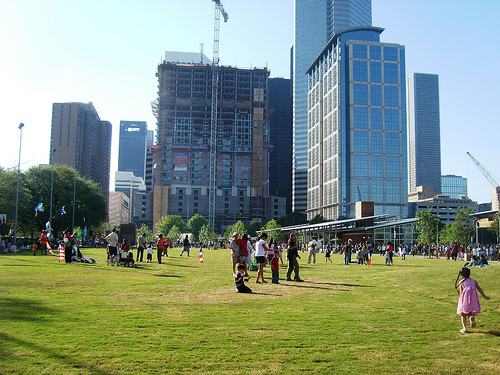
All too often Placemaking is viewed as a luxury, something nice but not essential to a project’s success. This is especially true in lean times like these, when every dollar is precious and paying too much attention to “frills” can feel frivolous or even wasteful. However, the reality is that Placemaking actually generates a big return on investment. Project for Public Spaces has seen this to be true all over the world, from a refurbished bus stop in L.A., which sparked the retail rebirth of a whole street, to the revitalization of entire cities. The success of Discovery Green in Houston proves this as it continues to spur reinvestment downtown since it's opening in 2008.
A Park Brings Vitality to an Overlooked Part of Houston
Discovery Green is Houston's first major downtown park. The project transformed 12 acres of underused green space and parking lots near the convention center into an urban oasis.
Working with Discovery Green Conservancy—a group of local foundations, philanthropists and civic officials—Project for Public Spaces facilitated a community visioning process to develop a program for the new park, which was conceived as “Houston’s backyard.” The PPS plan focused on creating a number of irresistible destinations in Discovery Green, since there were deep fears that no one would use the park in a downtown where only 3,500 people actually live. These destinations range from a one-acre lake with café, interactive fountain, and playground; a market promenade, enlivened by a farmer’s market on Thursdays; a signature restaurant, with event spaces and “tree house” balcony extending into the tree canopy; dog runs for small and large breeds; a stage and sitting lawn; as well as spacious lawns for recreational activities and events. The design was completed by Hargreaves Associates and a management plan was developed by ETM Associates.
The park opened in the spring of 2008, and has been phenomenally successful—an estimated quarter-million people visited the park between April and the end of June. A new restaurant built right in the park, The Grove, is doing far better than its preliminary estimates. According to Guy Hagstette, President of the Discovery Green Conservancy, “The meeting planners love the park, and it has helped Houston attract conventions and fill downtown hotel rooms.”
As soon as plans for the park were announced, a new highrise residential building, One Park Place, was proposed by a local developer. The building, with 21,000 feet of retail and 345 apartments, represents approximately $145 million of new investment. Last March, a new$300 million office building and retail center, Discovery Tower, broke ground on the north side of the park. Further, the city and Houston Endowment are partnering on an RFP for a new convention hotel on the last remaining empty block alongside the park, opposite the existing Hilton Hotel. Current estimates are for a project that will be in the $350-400 million range.

Widespread worries that people would not come to the park, which is located in what was until now an out-of-the-way part of downtown, have disappeared. One reason for Discovery Green’s success is the sense of ownership felt by people in the surrounding community. PPS initiated a series of meetings and workshops with downtown workers, neighborhood residents, cultural and environmental organizations, the Hispanic community, young people, and others. Virtually every group contributed valuable ideas that were incorporated into the park’s plans.
Insiders around Houston say the inspiring and inclusive vision for Discovery Green park helped attract unprecedented levels of funding from private foundations and donors. And those funders stayed engaged in the project, actively contributing to the planning and development of the park through the Houston Downtown Park Corporation and the Discovery Green Conservancy, which manages the park. According to an article in the Houston Chronicle: “The park is attracting development that’s bringing energy to east downtown. And the city’s $41 million investment in Discovery Green, coupled with twice that sum in private funding, has set a standard for parks that will influence public officials and donors for generations, park advocates say.”
The rich text element allows you to create and format headings, paragraphs, blockquotes, images, and video all in one place instead of having to add and format them individually. Just double-click and easily create content.
The rich text element allows you to create and format headings, paragraphs, blockquotes, images, and video all in one place instead of having to add and format them individually. Just double-click and easily create content.
Body Text Body Link
The rich text element allows you to create and format headings, paragraphs, blockquotes, images, and video all in one place instead of having to add and format them individually. Just double-click and easily create content.
Here is some highlighted text from the article.

Headings, paragraphs, blockquotes, figures, images, and figure captions can all be styled after a class is added to the rich text element using the "When inside of" nested selector system.
Headings, paragraphs, blockquotes, figures, images, and figure captions can all be styled after a class is added to the rich text element using the "When inside of" nested selector system.
Headings, paragraphs, blockquotes, figures, images, and figure captions can all be styled after a class is added to the rich text element using the "When inside of" nested selector system.

We are committed to access to quality content that advances the placemaking cause—and your support makes that possible. If this article informed, inspired, or helped you, please consider making a quick donation. Every contribution helps!
Project for Public Spaces is a 501(c)(3) tax-exempt organization and your donation is tax-deductible within the guidelines of U.S. law.
.avif)