
Las Ramblas

Gothic Quarter
Barcelona, Spain

Contributed by Project for Public Spaces

This series of pedestrian-oriented boulevards is so much a part of Barcelona that Spaniards coined a name for its users: "Ramblistas."

see also:

Click on any image for slide show


For more images of Las Ramblas or other places, try searching our Image Collection

Why It Works

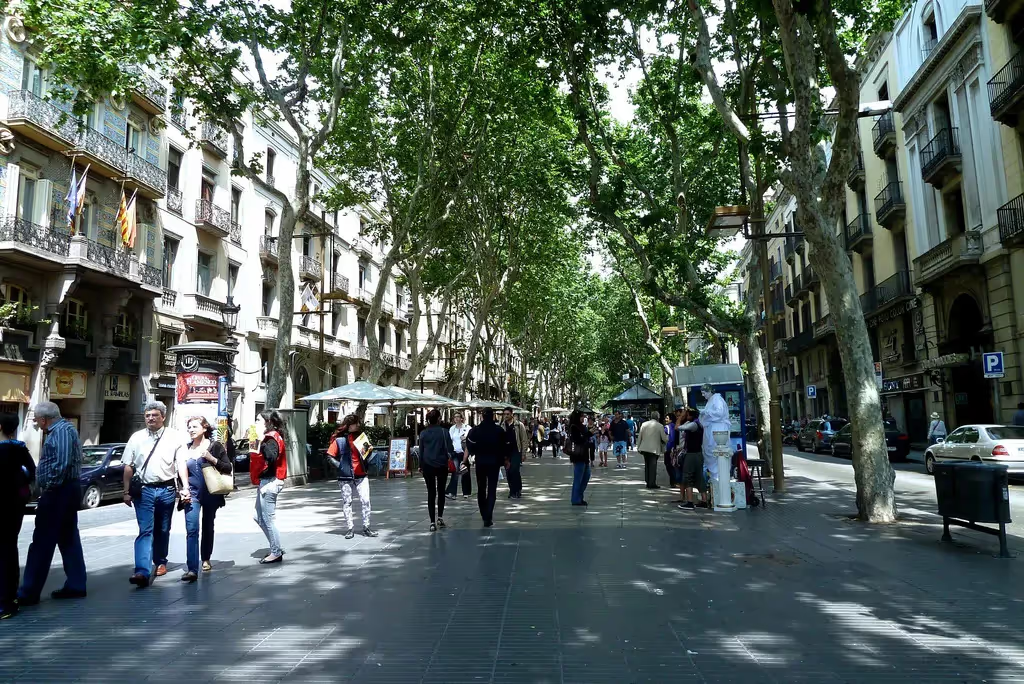
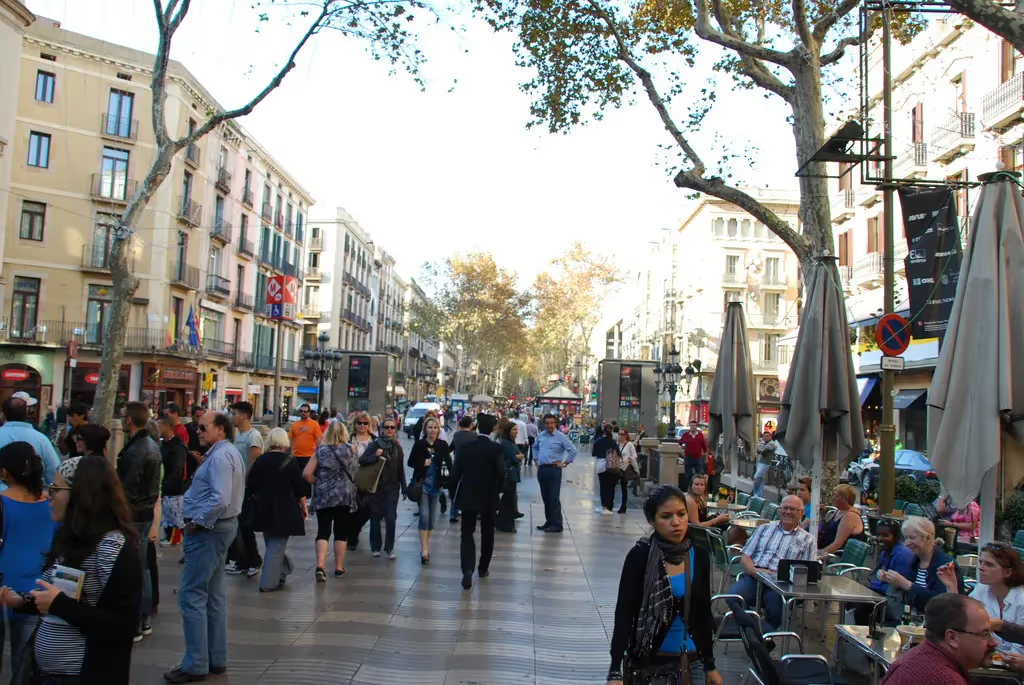
A tremendous variety of eateries, shops, markets, and cultural institutions can be found here, along with a huge number of pedestrians and people-watchers. About 1.5 kilometers long, Las Ramblas are really a sequence of three pedestrian-oriented street/boulevards. Its central pedestrian promenade is unique in many respects, not the least being its agreeable aesthetics (which come from its pleasant proportions, relative to adjacent development). Landscaping and provision of ample seating are two other big plusses.

The street is lined with five-to-seven-story buildings, street-level display windows, and many entrances. The central walkway is, on average, 60 feet wide; sidewalks are usually less than 10 feet wide, encouraging walking in the center. A row of trees separates the central walkway from automobile traffic - two lanes on either side (plus one parking lane). Pedestrians have precedence: Cars are relegated to narrow shoulder-lanes and must at every turn accommodate pedestrians, who are free of intersections in the central promenade.

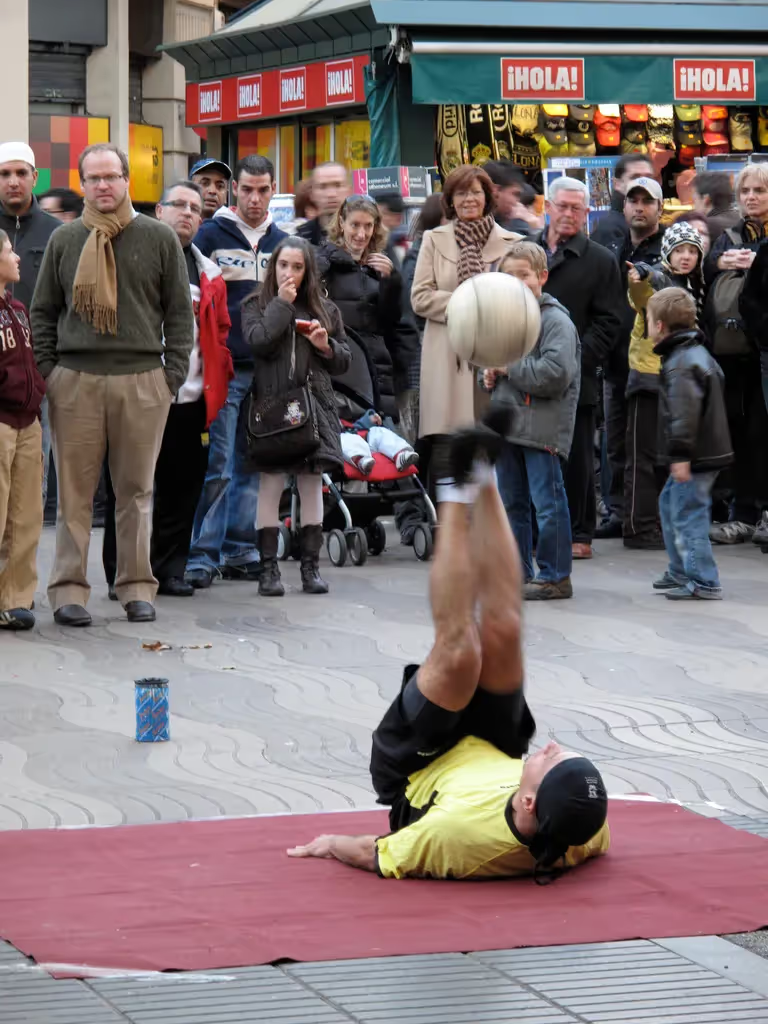
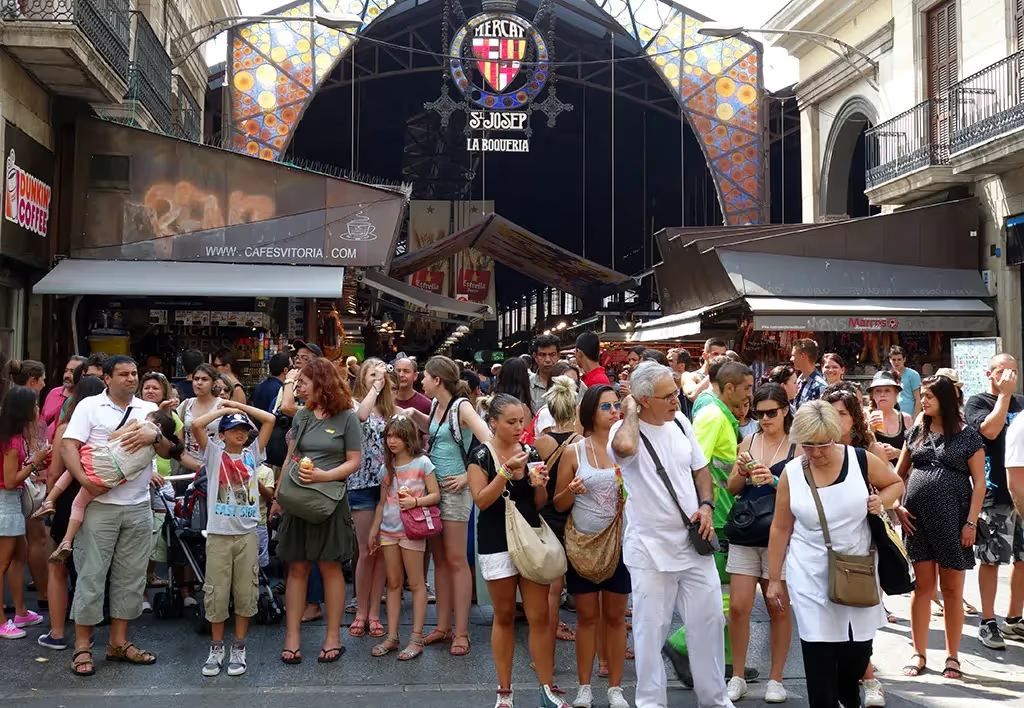
Therefore, pedestrian traffic is always high, partly because of the area's 24-hour attractiveness and partly because of the mixture of activities; regardless of the time of day, there is something to do. A huge number of different enterprises are in operation here - traditional retail, specialized vending, kiosk sales, markets and exchanges, fairs and exhibitions, seat rental, shoe-shining, eateries and pubs, entertainment, etc. There are also a number of museums and cultural institutions.

What Makes Las Ramblas a Great Place?

Major thoroughfare connecting central city plazas with waterfront by way of Gothic quarter; extraordinary pedestrian access from central promenade; walkable along entire length (less than one mile); excellent Metro access.

The proportion of street given over to pedestrians is quite pleasing, as is the harmony between street width, building height, landscaping, and intensity of usage. A mix of activities promotes diverse image and flexible character; Las Ramblas are seen as Barcelona's characteristic, most important, and best streets.

Pedestrian promenade and sitting area for people-watching, discussions, entertainment, etc.; retail and market space; exhibition space, festivals, bazaars, demonstrations. Restaurants, eateries, bars; cultural institutions, museums, monuments (Columbus statue, Canaletas fountain)

Convivial mixed-use retail/eating/entertainment area promotes sociability between users. Ample seating is provided along central promenade (benches, planters), with additional seating in vicinity of cafes and restaurants. Comfortable atmosphere promotes social contact; Ramblas have reputation as forum for interaction. Diversity of uses helps ensure a diversity of people.

History & Background

Las Ramblas are rich in tradition and history. The Font de Canaletas, an old iron fountain at the beginning of the promenade, has an associated legend: all those who drink from it are truly of Barcelona. The monument of Columbus at the waterfront end speaks to Spain's glorious imperial days. And the Ramblas itself, including the Placa de Catalunya at its head, has a secure and storied reputation as a center of high society, debate and discussion, and people-watching - so much so that it has actually entered the Spanish vocabulary: a "ramblista" is one who saunters along the Ramblas, perhaps making a day of it.

What is now Las Ramblas used to be a riverbed; a wall there marked the limits of medieval Barcelona. By the 15th century Barcelona had expanded past this wall, and the character of the Ramblas changed. In the late 18th century, construction began on the characteristic central pedestrian promenade, which replaced a section of the city wall. By 1856, all remnants of the old city wall had been torn down and Las Ramblas, by then Barcelona's main thoroughfare, looked much as it does today.

Related Links:

Back to top of page

User Comments:

> Add your own comment about Las Ramblas

09/04/02 xavier valls said:
La Rambla és el millor passeig del món.
07/03/03 Ben Adler said:
La Rambla is the biggest and best pedestrian experience one can imagine. Whereas the Champs Elysee has become so touristy that locals, at least young ones, don’t spend much time there, La Rambla is a beautiful pastiche of locals of all ages as well as tourists. It has a variety of places to sit, which is uncommon for such a busy thoroughfare. The police seem to have wisely taken a lax attitude towards loiterers, who are often selling art or drawing temporary tattoos for a small price. They add color, and keep the place hip enough to attract young Barcelonans. Many of the businesses along it have set up outdoor cafes, making the wide space seem more intimate. Every night I was in Barcelona I went to La Rambla and I've missed it ever since I left.
07/14/05 Christian Calleri said:
There aren't too many places like Las Ramblas! An amazing street. Check out Placa Real while you are strolling along, it is a small square just off the street's east side. It is truly incredible.
08/15/05 Kate Spaulding said:
This street is a culmination of culture and activity in Barcelona. The architecture is extremely varied and interesting. There are tons of people, vendors selling all kinds of wares, and the most "street performers" I've ever seen in one spot. (By street performers I also mean the people that dress up in crazy costumes and stand still until you pay them money and they do some sort of action, I personally find them really creepy). You can walk all the way down to the coast and the Columbus column, or simply hang out at one of the cafes and have the best Sangria of your life. Las Ramblas is a much more intimate Champs Elysees with exceptional character and charm.
09/16/05 Suzannah DesRoches said:
Does anyone know how I could get a plan drawing of Las Ramblas? I need a drawing of the length of it (with a known scale) for a class. Please help!!
04/03/06 Rully Adrian said:
have good sense of space on the boulevard, great space and place indeed.
08/13/07 diego rosa said:
Las Ramblas in Barcelona is approximately 1.2 kilometres long with Port Vell (near the cruise port terminal) at the Southern most end and Placa Catalunya at the northern most end. If you have your back to Port Vell and you are looking up towards Catalunya square along the Ramblas on your left hand side is the Raval area and on your right-hand side is the Barri Gotic (or Gothic Quarter). Barcelona Las Ramblas can also be roughly divided into seedy and non-seedy areas. This distinction between seedy and non-seedy becomes a lot clearer during the night time when the Southern most end of the Ramblas becomes something of a red light district and is frequented by night women (prostitutes). The northern most end of the Ramblas means north of the Liceu theatre (which is a mid way point along Las Ramblas) and the southern most end as being south of the Liceu Theatre. Transportation along Las Ramblas in Barcelona La Ramblas is primarily pedestrianised with only two narrow one-way traffic roads which run on either side of the central Ramblas Boulevard. Barcelona city council have restricted traffic flow through this region and you have the overwhelming feeling that pedestrians rule in this area (which makes a welcome change). Unlike other cities that have huge roads running through the middle Barcelona has chosen to structure the road system such that the heart of the city centre is primarily pedestrianised with larger roads that service the periphery. Barcelona Municipality seeks to reduce the flow of vehicles passing along the Rambla, including motorised two-wheelers, and thus to improve the pedestrian amenity of this world-famous promenade. The aim is to control the time, speed and type of vehicle that travels the section from Pg. Colom to Pça Catalunya, using a system of cameras to ensure an efficient enforcement. Around 10,000 vehicles per day use the Rambla to travel from Pg Colom to Pça. Catalunya. This volume of traffic includes significant numbers of public service and goods delivery vehicles. Whilst the service vehicle traffic is too great for the Municipality to consider a full, immediate pedestrianisation of the street, the number is small in comparison with pedestrian volumes which can exceed 7,000 persons per hour. Surveys undertaken by the Municipality indicate that a significant part of the flow of vehicles is through traffic, and that most of these vehicles pass at times when there is a high level of pedestrian activity. The Rambla also experiences a high number of accidents involving pedestrians. Cameras will record the movements of vehicles passing along the Rambla. Automatic number plate reading technology will be used to identify the passing vehicles. If the vehicle has a number recognising it as an authorised vehicle (on a “white list”), then the recorded image will be erased, with no action being taken. Any vehicle travelling at more than 30 kph, or one that does not belong to a “white list”, or which does not use one of the car parks will have its recorded images archived for use as evidence and a penalty fine will be imposed (to the owner of the vehicle). The automated system uses “black lists” to identify habitual offenders, and police can use the system to catch and prosecute habitual offenders or vehicles not showing a legal number plate. The supply of the remaining control gates and the development and management of the image processing system and its linkage with the Municipal enforcement centre are to be realised through a public tender, currently under preparation. The scheme is expected to reduce traffic volumes during the controlled hours by 40%. Such a result would provide a considerable improvement in pedestrian amenity and safety. The overall daily traffic is expected to be reduced by between 10 and 15%, with higher traffic levels prior to access control at 11.00 hours. Didac 13 August 2007
08/13/07 diego rosa said:
The Rambla is a boulevard that is transformed with the hours of the day and of the night. Few streets have such a marked capacity for changing their appearance, the rhythm of their life and even their smells and colours, depending on the season of the year and the time of day. In addition to being a street that preserves almost entirely its original characteristics, it has had, like no other thoroughfare, a capacity to assimilate the traces of the many and varied events that have taken place here during the different periods of its history. The Rambla is a street, and an experience, that remain in the memory.
08/13/07 diego rosa said:
The Rambla is a boulevard that is transformed with the hours of the day and of the night. Few streets have such a marked capacity for changing their appearance, the rhythm of their life and even their smells and colours, depending on the season of the year and the time of day. In addition to being a street that preserves almost entirely its original characteristics, it has had, like no other thoroughfare, a capacity to assimilate the traces of the many and varied events that have taken place here during the different periods of its history. The Rambla is a street, and an experience, that remain in the memory.
08/13/07 diego rosa said:
The Rambla is a boulevard that is transformed with the hours of the day and of the night. Few streets have such a marked capacity for changing their appearance, the rhythm of their life and even their smells and colours, depending on the season of the year and the time of day. In addition to being a street that preserves almost entirely its original characteristics, it has had, like no other thoroughfare, a capacity to assimilate the traces of the many and varied events that have taken place here during the different periods of its history. The Rambla is a street, and an experience, that remain in the memory.

> Add your own commentabout Las Ramblas

Back to top of page