
Between 18th and 20th Streets
Philadelphia, PA
Submitted by: KALYAN DASGUPTA
A gorgeous Center City landmark surrounded by a commercial and residential district.
Click on any image for slide show
For more images of Rittenhouse Square Park or other places, try searching our Image Collection
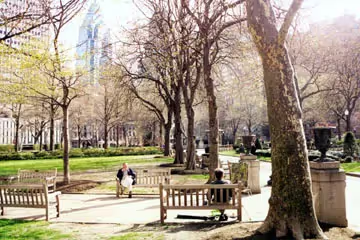
Rittenhouse Square is a gem in the heart of Philadelphia: a green, leafy oasis, bounded by Walnut Street, 18th and 20th Streets, Locust and Spruce. A variety of buildings, most of them architecturally notable, surround the park: elegant turn-of-the-century apartment buildings, brownstones, and the mansions that make up the Curtis Institute and the Art Alliance, as well as modern high-rises. The strip of Walnut Street near Rittenhouse Square features a good selection of upscale shops and restaurants, but the other streets near the park are more welcoming.
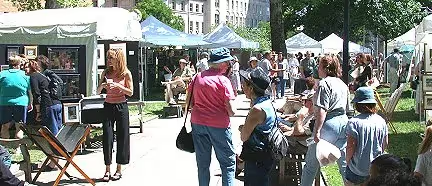
The space is among the best-used public spaces in the United States. Furthermore there is a sense of community here: an interaction between the habitues of the park that one actually feels that this is the City of Brotherly Love after all. People recognize each other and life here has a comfort and allure that has almost vanished everywhere else in the city and the country. The community's general affluence does help; but there is much more at work here.
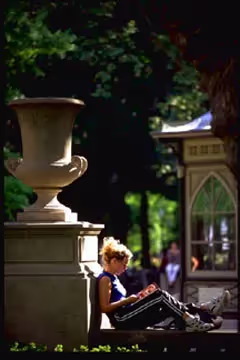
Rittenhouse Park is organic to its surroundings. It is separate from the aggressive hustle and bustle of the Walnut/Chestnut Street shopping areas, and its boundaries are well defined. Yet the park insinuates itself into the heart of these busy streets, separating them from the leafier residences on Locust, Spruce, Delancey and Pine Streets. It is of course accessible by foot, being in the heart of an east coast downtown, and of course by all means of public transport. It is eminently easy to hail a cab from Rittenhouse Park. The park also features some wonderful sculptures and is surrounded by some of the most elegant urban scenery in the United States. The relative compactness of Rittenhouse Park adds to its visual appeal, as does the elegance of its entrances.
Rittenhouse makes an immediate and striking impression for its green-ness and the beauty of the park itself, as well as the neighborhood around it, which features a great diversity of architectural styles as well as a mix of residential and commercial uses. The urbanist Jane Jacobs correctly describes this area of Philadelphia as the perfect urban neighborhood.
Rittenhouse Park features plenty of benches, each (it seems) with a personal dedication. This is truly a park beloved to its community - itself a beguiling mix of old money, new money, no money, Penn graduate students, young professionals and professional hobos. There are probably more women than men in the park. Families and their dogs and babies are plentiful in the park between six pm and nine pm. But there are people here at all hours of night and morning too. It is as safe, I think, as Philadelphia can get. This district, being home to many affluent and well-connected individuals, has a strong police presence. Crime has been falling in the city generally, and in this area is not regarded as a major problem. Rittenhouse Park (unlike lots of other places in Philly) is clean. Not just that, but it is a true public gathering place- a great place to sit and savor the offerings of one of the neighborhood's many interesting coffee places and bakeries, read the paper and people-watch.
Activities are a drawback, I suppose, to Rittenhouse. It is a small park and there are no particular amenities here. But it is green, there are interesting sculptures, and plenty of families and dogs. That said, users do vary greatly in age and gender. It is a favorite place to read the morning paper, sip coffee, or just take a break for all ages. All parts of the park are well used - the park, however, is just the center of an extremely robust neighborhood. Not all the neighborhood is as elegant as the park, but the diversity of options, from tree-lined streets like Delancey, to streets like Spruce, Walnut and Sansom that feature either shops and restaurants, housed either in large buildings, or in brownstones, add immeasurably to the connectedness of the park to its surroundings.
This is of course a favorite meeting place for Philadelphia residents. The community around it is diverse, albeit predominantly quite affluent - with several of the brownstones on nearby streets and several of the condos in elegant buildings such as the Barclay and 1830 Rittenhouse fetching $1 million or more on the market. However, unlike other cities, Philadelphia never seems intimidatingly posh or overly manicured. There are always plenty of down-to-earth people, of all ethnicities, and the concentration of University of Pennsylvania graduate students in the streets to the West of the park prevents this place from acquiring too much of an air of exclusivity. In any case, the park is the pride of many Philadelphians, I feel.
In its earliest days, the Square, then called Southwest Square, was a pasture for local livestock and a convenient dumping spot for "night soil". By the late 1700's the Square was surrounded by brickyards because the area's clay terrain proved better suited for kilns than for crops. In 1825 the Square was renamed in honor of David Rittenhouse, a brilliant Philadelphian astronomer, instrument maker and patriotic leader of the Revolutionary era.
By the 1850's a building boom began, and in the second half of the 19th century the Rittenhouse Square neighborhood became the most fashionable residential section of the city, the home of Philadelphia's "Victorian aristocracy." Some of the mansions of that period still survive on the streets facing the square, although most of the grand homes gave way to apartment buildings after 1913.
Fairmount Park Commission General Information: 215-685-0000
> Add your own comment about Rittenhouse Square Park
> Add your own commentabout Rittenhouse Square Park
All spots of the park are used by all ages and races. Plenty of benches to sit, or space on the grass to lie down. Fountain that dogs enjoy taking a dip in. Lots of children playing.
Everyone meets people in Rittenhouse Square - it's a very sociable place where people enjoy themselves.
Accessible to everyone with plenty of entrances on all sides. Everyone uses it whether just passing through or to stay for a while.
Mike C (who was involved in a public spaces project with the European Commission)
There are three distinct attributes that make Rittenhouse work. The first, and most important, is that it is exactly positioned at the boundary between a dense residential district and the city's retail and financial district, so that it is constantly being traversed by people moving between the two. (This is probably the main reason the three other squares of the original Philadelphia plan--which lack this locational advantage--don't work as well.) The second is that the buildings surrounding it are in beautiful scale with the width of the square (they feel about as tall as the square is wide, though they're not really), so that they form a "wall" around the square and give it a sense of enclosure, just like a room (all great squares do this, but not many in the US). Third, Paul Cret's masterful plan, which criss-crosses the park with uninterrupted diagonals as well as more circuitous but still geometric paths, beautifully accommodates both the purposeful route of the pedestrian and the leisurely route of the idler, with plenty of spots for the two to interact.
Perhaps just as interesting as what the park has is what it DOESN'T have: no pointless stairs, changes of elevation, waterfalls, berms, bollards or other landscaping histrionics so favored in trying to accessorize American urban spaces. In fact, there are precious few actual landscaping features other than walks, benches, trees, flower beds and a small ornamental pool that sometimes has water in it.
As a final note, I'd argue that the "overly restrictive" aspect mentioned by a previous commenter is a benefit. Riding bicycles on the sidewalk is dangerous for pedestrians, and in fact it's illegal everywhere in Philadelphia. That it's enforced in Rittenhouse makes it one of the few places people afoot are protected from this menace, and residents who see the police so doing gain a sense of confidence about the space that contributes to its ultimate use and liveliness.