Close Menu
Menu
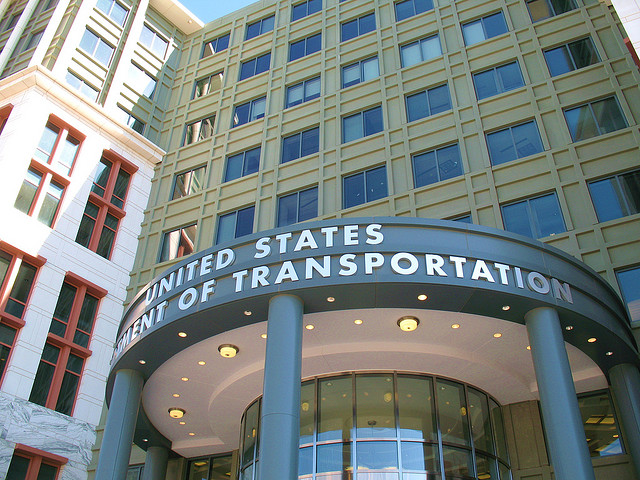
A few years back, I paid a visit to the headquarters of a state DOT, for the purpose of helping to plan its Safe Routes to School program. As DOTs went, this one had a reputation for being fairly amenable toward pedestrians, by which I mean that the department in question considered walking to be a legitimate form of transportation, which was eligible for spending federal transportation dollars. That, of course, doesn't always seem to be the case.
Returning from lunch (in a car, because we certainly weren't in a mixed use neighborhood) we encountered a pedestrian about to cross the DOT's driveway apron. The driver, being both a human being and a law-abiding citizen, yielded to the pedestrian. But the ped stopped and waived us through. We insisted, and after a confused shrug, he proceeded along his right-of-way. Some might read this merely as a courteous interaction between two users of the transportation system. I saw something more sinister: a microcosmic reminder of the hierarchy at play on our nation's roads, in which the convenience of the driver subordinates all other forms of transportation. I immediately cracked a joke that the yielding pedestrian was probably a traffic engineer. (As it turned out, he was.)
Entering the building I noticed, next to the front door (kudos!), what is to date the saddest, loneliest, and rustiest specimen of a wheel-bender bike rack that I have ever seen. I was begged not to take a picture of it. (I did anyway, and framed it nicely with the DOT's name placard above the front door. Sadly, I've lost track of the photo...it's gone to the great digital beyond.) My final reward came at the end of the day when, upon exiting the building into the parking lot, I stepped out onto a raised, textured crosswalk. I joked: this is the only raised crosswalk in the state, and it's in the DOT's parking lot! My smirk turned into a grimace when I was informed there was a not-so-funny reason for that particular traffic calming feature being exactly where it was.
I had largely forgotten about this experience until I received a call recently from a reporter who was doing a story on a spate of pedestrian deaths where he lived. As one who aced the state capitals quiz in 7th grade Geography, I immediately recognized the city in question was also that state's seat of government. After examining the corridor where the deaths occurred—a multi-lane, high-speed, no-median, state road lined with strip retail development—I located the state DOT's headquarters, which happened to be a 10-second drive from the road in question, at the confluence of an expressway and a sea of parking.
I had to wonder: if we are what we eat, do we also design what we experience? It isn't hard to imagine that, deep within the bowels of the state DOT, there are people who've never ridden transit, who've never walked to lunch, who live a suburban lifestyle, who cannot imagine their children walking to school, and who haven't ridden a bike since they passed their driving test? Should it be a surprise to us that driving is the first thing the engineer or planner thinks about when he or she sits down to review a plan for a bridge, an intersection, a corridor, or a roadway "improvement"?
We decided to have some fun with Walkscore and state DOT headquarters. We found the address for each state headquarters office and found that the average walkability rating for state DOT headquarters offices is a paltry 67.4. As any high school student can tell you, that's a barely-passing "D" grade. Below is a slideshow of the eight state DOT offices with Walkscores below 50, which the site categorizes as "Car-Dependent." We've ranked them from best (or: least horrible of the worst) to worst. Take a look, and then let us know how well the built environment around a your state's DOT correlates to its consideration for walking, bicycling, and transit.
UPDATE: You can also click here to download the list of all 50 DOT offices, ranked by Walkscore.
The rich text element allows you to create and format headings, paragraphs, blockquotes, images, and video all in one place instead of having to add and format them individually. Just double-click and easily create content.
The rich text element allows you to create and format headings, paragraphs, blockquotes, images, and video all in one place instead of having to add and format them individually. Just double-click and easily create content.
Body Text Body Link
The rich text element allows you to create and format headings, paragraphs, blockquotes, images, and video all in one place instead of having to add and format them individually. Just double-click and easily create content.
Here is some highlighted text from the article.

Headings, paragraphs, blockquotes, figures, images, and figure captions can all be styled after a class is added to the rich text element using the "When inside of" nested selector system.
Headings, paragraphs, blockquotes, figures, images, and figure captions can all be styled after a class is added to the rich text element using the "When inside of" nested selector system.
Headings, paragraphs, blockquotes, figures, images, and figure captions can all be styled after a class is added to the rich text element using the "When inside of" nested selector system.

We are committed to access to quality content that advances the placemaking cause—and your support makes that possible. If this article informed, inspired, or helped you, please consider making a quick donation. Every contribution helps!
Project for Public Spaces is a 501(c)(3) tax-exempt organization and your donation is tax-deductible within the guidelines of U.S. law.

.avif)