Close Menu
Menu

Sweeping changes in the judicial system and society call for courts to become civic gathering spots [T]he story that a building tells through its design may be as important to the community it serves as is its function. By shaping our thoughts about ourselves and our institutions, it will directly affect our efforts to work productively together. -- Justice Stephen G. Breyer (United States Supreme Court, 1994--present)
The courthouse used to be a cornerstone of the community, a source of local pride and the nexus of social life and ritual. But today, courthouses and the public spaces that surround them are often physically and programmatically disconnected from public life, even though they usually occupy central property in a community. Citizens don’t visit their courthouses unless compelled to do so, and very few serve as public destinations.
The good news is that court properties have much potential for resurgence when there is positive leadership, open-minded management, and the desire for change. Courts have the opportunity and responsibility to serve as integral places, key parts of the communities in which they reside. Courts are, after all, the people’s houses of justice, and only by becoming engaging places can they live up to their potential.
While early American courthouses often shared space with other public institutions (like the post office or the county clerk) and were heavily used, more recent court design has encouraged segregation and specialization of uses, so that citizens have little reason to enter the doors of court buildings. The design of court facilities has shifted from welcoming to foreboding, and from public to monumental. The resulting diminution of the courthouse’s community role is indicative of a larger trend: a widening disconnect between the judicial system and public life. While courts are busier than ever, trials are vanishing, and more cases are resolved by private settlement or in non-public forums. Through such privatization, court spaces are no longer truly civic, and don’t support community vitality.
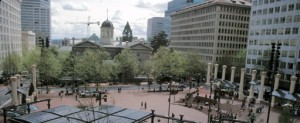
What is needed – and a real opportunity – is a fundamental reconsideration of how we think about and design court spaces. If courts find ways to recapture their relevance and resonance within communities, they could once again become civic destinations that engage with and respond to their users.
Project for Public Spaces is committed to playing a key role in facilitating these discussions. PPS has worked extensively to revitalize many types of civic centers, including courthouses, post offices, museums, libraries, and seats of government. Since 1999, PPS has partnered with the General Services Administration’s Good Neighbor Program in helping communities envision public spaces that will draw a variety of people, uses, and activities. PPS has worked in this capacity in almost two dozen cities.
PPS’s extensive placemaking experience with civic centers, and our history of collaboration with GSA, give us a strong foundation on which courts of all types can build in fulfilling their potential as true civic destinations.
* * * * *
By Karen Levy with Fred Kent, President and Cynthia Nikitin, Civic Anchors Program Director for Project for Public Spaces, Inc. Karen Levy is an attorney and is currently pursuing a doctoral degree in sociology at Princeton University. Karen has been working with Project for Public Spaces as an Arthur Liman Public Interest Summer Fellow, a program sponsored by Yale Law School and Princeton’s Program in Law and Public Affairs.
The rich text element allows you to create and format headings, paragraphs, blockquotes, images, and video all in one place instead of having to add and format them individually. Just double-click and easily create content.
The rich text element allows you to create and format headings, paragraphs, blockquotes, images, and video all in one place instead of having to add and format them individually. Just double-click and easily create content.
Body Text Body Link
The rich text element allows you to create and format headings, paragraphs, blockquotes, images, and video all in one place instead of having to add and format them individually. Just double-click and easily create content.
Here is some highlighted text from the article.

Headings, paragraphs, blockquotes, figures, images, and figure captions can all be styled after a class is added to the rich text element using the "When inside of" nested selector system.
Headings, paragraphs, blockquotes, figures, images, and figure captions can all be styled after a class is added to the rich text element using the "When inside of" nested selector system.
Headings, paragraphs, blockquotes, figures, images, and figure captions can all be styled after a class is added to the rich text element using the "When inside of" nested selector system.

We are committed to access to quality content that advances the placemaking cause—and your support makes that possible. If this article informed, inspired, or helped you, please consider making a quick donation. Every contribution helps!
Project for Public Spaces is a 501(c)(3) tax-exempt organization and your donation is tax-deductible within the guidelines of U.S. law.

.avif)