The Placemaking Round-Up
A biweekly newsletter with public space news, resources, and opportunities.
The Biweekly Bazaar
A curated dispatch on all things public markets plus the latest announcements from the Market Cities Program.
A biweekly newsletter with public space news, resources, and opportunities.
A curated dispatch on all things public markets plus the latest announcements from the Market Cities Program.
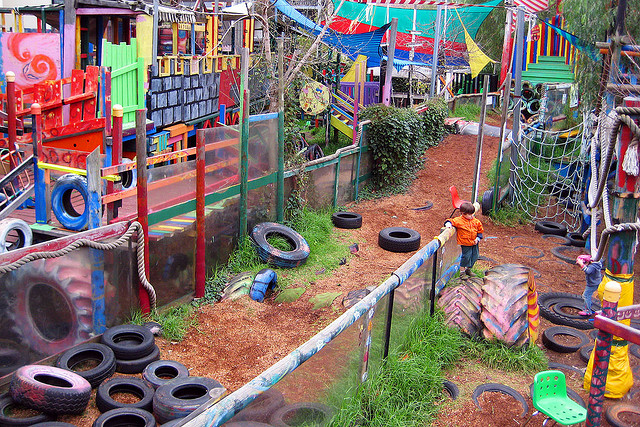
I don't know about you, but when I was a kid, I don't think I ever once used a "play structure." I can still vividly remember the playground at my elementary school, with its castles, pirate ships, Amazonian treehouse cities, secret lairs, and rivers of lava. My friends and I never thought of the wooden pavilion, the monkey-bars, or the giant tire off in the corner of the lot as what they actually were. The term "play structure" did not apply--there was nothing structural about the way that we used that place.
Today, of course, that same corner of the school yard is occupied by a brightly-colored construction that is very safely bolted to a rubber pad. Gone are the wood chips (which served as gold doubloons, secret keys, magic gems...), the giant tire, and anything remotely resembling a treehouse. There is a slide, and big plastic blocks with Xs and Os on opposing sides, where children can enjoy hours and hours of unstructured tic-tac-toe. If such a thing exists.
This is an all-too-common story, and one that you probably know well. Over the past few years, we have siloed different types of play within playgrounds, just as we have siloed different types of uses in cities. Pieces of play equipment that might be transformed into fantastical alternate worlds when jumbled together are isolated (a slide here, a tire swing there), underlining that each piece is meant to be used in one specific way. But research and support have been mounting for years to back up what many of us feel on a gut level: these sanitized playscapes are junk.
There has been a recent burst of interest in adventure playgrounds, which "depend on 'loose parts,' such as water, sand, balls, and other manipulable materials." Thoughtful articles from The Guardian's Justin McGuirk, Kill Screen's Yannick LeJacq, and Cabinet magazine's James Trainor have each explored the history of this movement within the past couple of months, revisiting everything from Aldo van Eyck's work in Amsterdam following WWII, to the unique cast of characters (Richard Dattner, M. Paul Friedberg, Lady Allen of Hurtwood, et al) behind the surge of interest in London and New York in the 1960s. To see so much solid new writing on this subject should be encouraging to anyone who hopes to see kids playing amidst wood chips again. Unstructured play is having a moment, and moments are meant to be seized.
Cities are where us "grown-ups" play at leading meaningful and enjoyable lives, so it may be helpful (if anecdotal) to think of playgrounds as the staging areas for the cities of tomorrow. If we want to live in siloed cities, with offices here, houses there, and all quarters safely demarcated by wide arterial roads, we should probably go right on ahead building playgrounds where the slides and plastic tic-tac-toes cower away from each other. But if we want bustling, creative cities full of the surprise and serendipity that makes urban life so enjoyable, we might want to start thinking about playgrounds as microcosmic multi-use destinations.
I think of my favorite public space now, Washington Square Park, and it reminds me, in a way of that schoolyard playground. There are so many different things happening at any given moment: people are playing music, and games, they're kissing, chatting, taking photos, sunning, jogging, and watching the world pass by. The magic of that park is in its open-endedness, and its mix of these activities. That's what a great place looks like.
Shouldn't our playgrounds be great places, too?
The rich text element allows you to create and format headings, paragraphs, blockquotes, images, and video all in one place instead of having to add and format them individually. Just double-click and easily create content.
The rich text element allows you to create and format headings, paragraphs, blockquotes, images, and video all in one place instead of having to add and format them individually. Just double-click and easily create content.
Body Text Body Link
The rich text element allows you to create and format headings, paragraphs, blockquotes, images, and video all in one place instead of having to add and format them individually. Just double-click and easily create content.
Here is some highlighted text from the article.

Headings, paragraphs, blockquotes, figures, images, and figure captions can all be styled after a class is added to the rich text element using the "When inside of" nested selector system.
Headings, paragraphs, blockquotes, figures, images, and figure captions can all be styled after a class is added to the rich text element using the "When inside of" nested selector system.
Headings, paragraphs, blockquotes, figures, images, and figure captions can all be styled after a class is added to the rich text element using the "When inside of" nested selector system.

We are committed to access to quality content that advances the placemaking cause—and your support makes that possible. If this article informed, inspired, or helped you, please consider making a quick donation. Every contribution helps!
Project for Public Spaces is a 501(c)(3) tax-exempt organization and your donation is tax-deductible within the guidelines of U.S. law.
.avif)