gtoth@pps.org

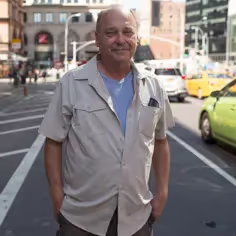
Gary Toth is Director, Transportation Initiatives with the Project for Public Spaces. He is an experienced leader with substantial expertise in transportation planning, particularly the integration of transportation with land use planning and Context Sensitive Solutions. He possesses a wide ranging network of relationships resulting from participation in many national transportation committees, projects as well as speaking engagements around the country.
During his thirty four years of project management experience within the New Jersey Department of Transportation (NJDOT), Gary become known for his collaboration and facilitation skills, and was one of the architects of the transformation of NJDOT to a stakeholder inclusive process. This lead to his being a founding member of the NJDOT’s Context Sensitive Solutions (CSS) program, and has helped NJDOT become a national leader in CSS. He is a sought after resource and speaker on CSS and Integrating Transportation and Land Use at many venues, including National and Regional workshops. He is one of the eight instructors for the National Highway Institutes Training Course for Transportation and Land Use.
Gary’s work with AASHTO and TRB, as well as his subsequent experience, has brought him into contact with the operations of many state DOTs around the country. This has led him to become one of the leading experts in the country on what “makes DOTs tick”, and how to engage the transportation planning, funding, project development and design processes to achieve sustainable and livable outcomes.
PROFESSIONAL EXPERIENCE
Integrating Transportation and Land Use: Gary has been one of the national leaders in the movement to integrate transportation and land use. As Director of Project Planning and Development at NJDOT, Gary shifted the focus of major investment studies from costly, controversial and unsustainable major capacity increases to a more balanced approach. This approach, embodied in the NJFIT, Future in Transportation program, seeks to address congestion in more sustainable and affordable ways including collaborating with local communities on network connectivity and land use planning and partnering with the developers and stakeholders to align development infrastructure in ways that can contribute to the public solution.
- Gary helped form the Task Force on Transportation and Land Use, a partnership between the state DOTs of Pennsylvania and New Jersey, and the Delaware Valley Regional Planning Commission. He has provided subject matter expertise on integrating transportation and land use to Maine DOT, New York State DOT, Connecticut DOT, Pennsylvania DOT, the Chatham County-Savannah MPO, the Surface Transportation Policy Project, the North Atlantic Transportation Planning Officials, National Community Impact Assessment Committee, Northeast Association of State Transportation Officials, and at the September 2005 Executive Seminar on Transportation and Land Use, hosted by AASHTO and the National Cooperative Highway Research Project.
Instructor, National Highway Institute’s Training Course for Transportation and Land Use: Senior Instructor for sessions in Chicago (April 2008); Los Angeles (June 2008); Eugene (October 2008); Schenectady (January 2009); Binghamton (March 2009); and St. Paul (June 2009).
Subject Matter Expertise support for State DOTs as a consultant to the Federal Highway Administration: Gary is under contract to FHWA to provide customized expertise to selected state Department’s of Transportation. The state DOT’s are New Mexico, Illinois, California, and Texas.
Subject Matter Expertise support for the Transportation for America (T4A) Campaign: Gary is under contract to the T4A Campaign to support local coalitions working to ensure appropriate expenditure of Federal Stimulus funding. States supported include Minnesota, Michigan, Wisconsin, Georgia, Pennsylvania and South Carolina.
Street Design and Planning
- Abu Dhabi Context Driven Urban Street Design and Mobility Standards Manual: subject matter expert brought in to work with professionals from the Emirate of Abu Dhabi.
- New York City Design Manual (released May, 2009): subject matter expert review of the Manual. Offered suggested changes, all of which were incorporated or scheduled for follow-up products.
- Los Angeles Community Redevelopment Agency: Gary has been providing technique advice on Street and Network design as part of the Los Angeles Placemaking Academy
- American Public Transit Association: As part of the Sustainable Urban Design Committee, Gary the primary author of a paper on Street and Network Design for Transit Agencies, and a contributor author to a paper on Land Use and Density standards for Transit Oriented Development.
- Information and Technology Platform for Transport, Infrastructure and Public space (CROW) Netherlands: Transportation liaison for the Project for Public Spaces information exchange with CROW regarding street design and its application to community based transportation.
Context Sensitive Solutions: Gary is one of the originators of the NJDOT Task Force on Context Sensitive Design (CSD). He was the team leader for both NJDOT’s CSD Implementation Team as well as training for Context Sensitive Solutions, with over 800 trained.
At the Project for Public Spaces, he is an instructor and part of the development team for the Project for Public Spaces Streets as Places Training Program and Campaign.
He has participated in workshops or peer reviews on CSD or Community Impact Assessment (CIA) in Maryland, Georgia, Connecticut, Washington D.C, Indiana, and Oregon. He has been a member of the National Community Impact Assessment Design Team since 1998, and his Division organized three day Northeastern Workshops on Community Impact Assessment in 2001 and again in 2005. As a member of the AASHTO Task Force on Context Sensitive Solutions, Gary helped redraft the National CSS principles, develop the Task Force’s strategic Action Plan, and prepared a one page flyer for DOT CEOs, entitled “How CSS Can Help You Meet Your Agency’s Mission”. He was the Keynote Speaker on CSS at a 2004 Georgia DOT Symposium on CSS.
Stakeholder Collaboration: Gary has had a multitude of experience and a wealth of training on collaborating with a wide range of stakeholders to bring a wide range of competing interests towards a common goal.
Management: Gary has over 25 years of experience in managing and directing professional staff. He was renowned within NJDOT for championing diversity, and challenging staff to highest levels of professional development. As Director, Project Planning and Development, he managed a staff of 66, with a salary budget over $5 million; and a consultant engineering budget of $25 million. His Division was responsible for a program of over 100 projects, and for delivering over $500 million dollars of new design and construction starts each year.
PUBLICATIONS AND PRESENTATIONS
- “Reducing Vehicle Miles Traveled, Can We Really Pull it Off” published in Driving Climate Change: Cutting Carbon from Transportation, Elsevier Press, 2006
- NJFIT: Future in Transportation, Back to our Roots? 2006 ITE Annual Conference.
- Report of the AASHTO Task Force on Corridor Preservation (1990), Editor and Contributing Author
- A Citizen’s Guide for Successfully Engaging Your DOT (Published September, 2008 via PPS and AARP)
- Back to Basics in Transportation Planning (Published PPS November 2007; published by the Eno Foundation January, 2008)
- Streets as Places Training, Principle Trainer, Engaging your DOT plus Flexible Design Components
- Federal Highway Administration Corridor Level Handbook (produced by PPS 2007)
PROFESSIONAL ASSOCIATIONS
- Board, AASHTO/FHWA Context Sensitive Solutions web site
- AASHTO Context Sensitive Solutions Task Force
- American Public Transportation Association, Sustainability and Urban Design Standards Working Group
- National Surface Transportation Policy and Revenue Study Commission, Sustainable Transportation Issues Panel (Energy, Environmental Stewardship, Land Use, and Transportation Development)
- Transportation Research Board Community Impact Assessment Subcommittee
- Transportation Research Board Sustainability and Transportation Committee
- 2006 AASHTO National Peer to Peer CSS Workshop Steering Committee
- 2006 American Society of Civil Engineers Conference on CSS Steering Committee
- Strategic Highway Research Program Technical Coordinating Committee (Capacity)
- FHWA Environmental Justice Training development team (2001).
- Transportation Research Board Special Panel on Corridor Preservation (1993).
- American Association of State Highway and Transportation Officials Task Force on Corridor Preservation Secretary/Recorder (1988-1990)
- Certified Public Manager in New Jersey.
EDUCATION
Bachelor’s of Engineering (Civil), Stevens Institute of Technology, 1973
Air Quality Post Grad work (12 credits) Stevens Institute of Technology ‑ 1975‑1976
Environmental Management Institute, a 12 credit program in Public Administration and Environmental Management , University of Southern California, 1980
SELECTED PROJECTS
Context Sensitive Solutions Implementation at NJDOT: Gary is one of the originators of the NJDOT Task Force on Context Sensitive Design (CSD), and led its evolution into Context Sensitive Solutions over the past few years. During that period, he has been responsible for the development and adoption of a CSD Policy for NJDOT, the formation of first a CSD Implementation Team and its later evolution into a CSS Implementation Team, and finally, he was the team leader for NJDOT’s training for Context Sensitive Solutions, with over 800 NJDOT engineers and planners, AND community members and stakeholders trained.
Streets as Places Campaign at Project for Public Spaces: Under the leadership of Gary Toth, the Project for Public Spaces has put together a program called Streets as Places campaign. This campaign represents a broad effort to engage the transportation industry to transform transportation policy and practice in order to be supportive of community outcomes. In most modern examples of community planning, the transportation planning is done separately from community planning, and community goals are usually forced to react to transportation decisions that are focused solely on throughput for the automobile.
The Streets as Places Campaign has several components:
Transforming Transportation Practice: which includes outreach to DOTs and other transportation agencies
Publications: Gary Toth has already published an article which is receiving national attention, called Back to Our Roots. Gary, through a partnership between PPS and AARP, is also about to publish the landmark Citizens Guide to Engaging Your DOT for Successful Outcomes
Training: Gary was one of the key architects and instructor for PPS’s Streets as Places Training. One of the key modules of this training is a How To session on Flexible Design.
A Guidebook for Smart Transportation Solutions in Pennsylvania and New Jersey: Gary was one of the originators of the process to create a Guidebook for Context Sensitive Solutions in Pennsylvania and New Jersey. He helped forge a partnership between the New Jersey Department of Transportation (NJDOT), Pennsylvania Department of Transportation (PennDOT), and the Delaware Valley Regional Planning Commission (DVRPC) to create a guidebook which is based on a series of Roadway Design Templates to help each address ever increasing desires from their customers for Context Sensitive projects which are integrated in land use frameworks. The Guidebook was published in March, 2008.
Route 71 Avon by the Sea: (Director) In Avon by the Sea, NJ State Route 71 was a high speed four lane roadway which was “rightsized” to two lanes with a landscaped median and substantial streetscaping. Traffic speeds were slowed to 30-35 mph, and the ease of pedestrian crossing was substantially improved
Trenton Waterfront Transportation and Land Use Study: The Route 29 Waterfront Boulevard Study will eliminate the Route 29 freeway section and replacing it with an Urban Boulevard to provide open space along the Delaware River and improve access to the river. It aims to transform the character and function of Route 29—from an expressway that carries traffic past the city into a context sensitive boulevard which can feed the revitalization of Trenton’s downtown waterfront.
Newark Waterfront Community Access Study: (Director) The Newark Waterfront Community Access Study (NWCAS) was a Public Outreach Program undertaken by the New Jersey Department of Transportation to determine pedestrian access links from Downtown Newark to the Passaic Riverfront park across McCarter Highway (Route 21). NJDOT worked to build consensus among local stakeholders for provisions along the highway to enhance pedestrian access.
Route 206 Princeton Vision Plan: Route 206 is a major NJ State Highway which runs north/south for the entire length of the state. It also serves a local street function for the Township of Princeton. At the communities request, Gary brought together a team of specialized consultant expertise, NJDOT traffic engineering, design and bicycle pedestrian specialists, to partner with the community to develop a vision which allows Route 206 to continue to serve as a key state highway, but to do so while respecting the context of the community. Several roundabouts are proposed, as well as streetscaping, medians, and gateway treatments.
Route 206 Hillsborough Bypass: The Hillsborough Bypass is a long studied project which was originally intended to be constructed as a 55 mph high speed freeway. This design created major controversy and conflict between the two host communities and NJDOT and the host county: Somerset County. Gary used his collaboration and facilitation skills to help defuse a politically charged environment which was destined for major court battles. He brokered a new solution which met with the satisfaction of all, allowing the bypass to be constructed, but to do so in a way which did not unduly impact the host communities, particularly Montgomery to the south.
Route 9 Integrated Land Use and Transportation Plan, Ocean County: (Director) This project involved working with 12 communities on integration of transportation and land use planning within a 30 mile section of Route 9 in Ocean County, from Toms River in the north, to the Ocean County/Atlantic County line in the south.
Under Gary’s leadership, NJDOT succeeded in forging an alliance where the 12 communities, various state agencies and the County all signed a partnering agreement to to work together on integrating transportation and land use.
Route 31 Flemington Area Congestion Mitigation Study:
This planning effort, located in the Flemington area in Hunterdon County, involved the elimination of a long studied and unaffordable freeway and replaced it with a right sized and context-sensitive “bypass”. The “South Branch Parkway” would also include new local network additions and land use planning for future mixed use, compact and walkable development.
Route 57 Corridor Preservation Plan, Warren County: The Route 57 study encompassed 21 miles of Route 57 from Philipsburg to Hackettstown and included 8 municipalities. This effort is a four part innovative planning process which involved partnering with local communities and state agencies to plan development to avoid sprawl which would overburden the state highway and lead to context insensitive solutions. Supplemental goals involved helping the region’s communities develop implementable and sustainable vision plans for themselves. It is included demonstration Plans and Design Guidelines as well as an Implementation Toolkit which can be used by municipalities and counties for planning future development.